Everything was fine after the half-marathon. Everyone was happy, I was happy and I thought things would remain on Cloud 9, until my knee decided to go on vacation.
Within a week of trying to get back into training, my knee hurt so much that I couldn’t even walk. Walking up and down the stairs was a nightmare, with pain shooting through it at every step and even going to the toilet was painful. I never thought I would get such an injury and when I was feeling the effects of it for the first time, I thought my plans for the marathon had fallen through the roof.
Alongside the whole chaos about the coronavirus spreading across the country, lockdown and the shutting down of the university (what a way to end my undergraduate degree but hey), I had no idea on how I am going to even continue my training. The marathon has been postponed to October and I may not even be in the country then.
The way I approached my injury in the beginning was pretty bad. As someone who hates sitting around and trying to wait for things to get better, I tried to run even though I knew my knee could hurt and I did hurt it really badly afterwards. Taking this into account and considering we learned about how personality could affect someone’s performance in something or how they approached things in life, I thought I might as well try out the 16 personalities online test aka the Myers Briggs test.
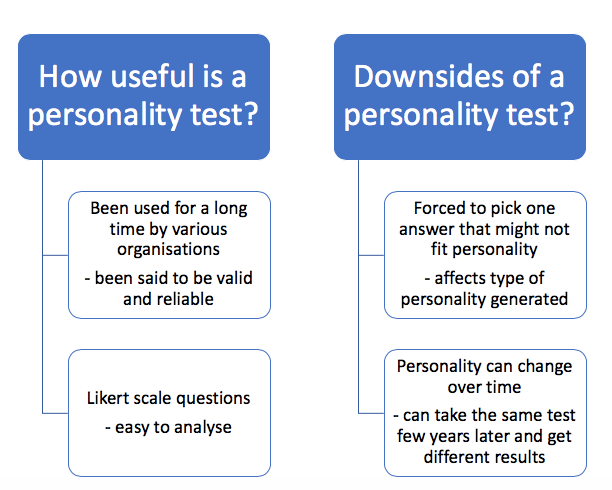
While it has been widely used across the years (Pittenger, 1993), this differs according to different researchers (Capraro & Capraro, 2002; Stein & Swan, 2019) of the research papers analysed. Capraro and Capraro (2002) claimed that the test was valid with high correlation scores, others said the test wasn’t reliable as people are forced to pick between several choices, which could have made them pick an answer that wasn’t quite suitable for them. When I was answering the test, I found that I was answering a lot on the extreme scale of things and there were answers I wasn’t sure of, which could have affected the final outcome of which personality type I was allocated to.
There is also the issue of people’s personality types changing across the years as I recalled that my personality type wasn’t what I had got this time. Some studies found that personality can change across the lifespan, particularly in adolescent years (12 to 18 years old) (McCrae, et al., 2002) and later in life (Specht, Luhmann & Geiser, 2014).Personality may also be affected by where a person lives and the environment they are in as it was found that people who come from cultures of conforming in a group may develop a certain personality type. Being from a certain culture influences how a person’s ethical mannerisms work, showing that being in a certain culture could potentially influence your personality (Rawwas, 2001) After living here in the UK for the past three years and being in a society that is a bit less conforming from my home country, there may be a possibility of me having more freedom to explore myself here, which could have resulted in my personality changing.
So my results for the personality test is ISTP-T, which is shown in the picture below. While I am taking this test result at face value and not letting it rule out the possibility of my personality being a bit different, I have to agree at what some of my individual traits are and what they stand for.
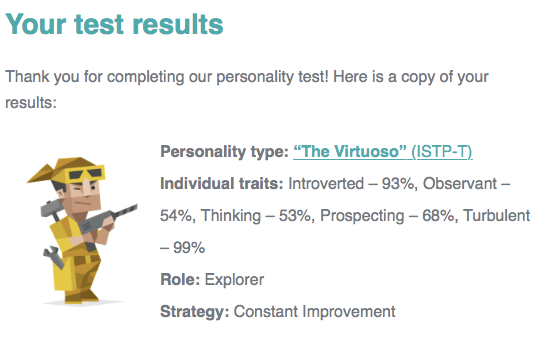
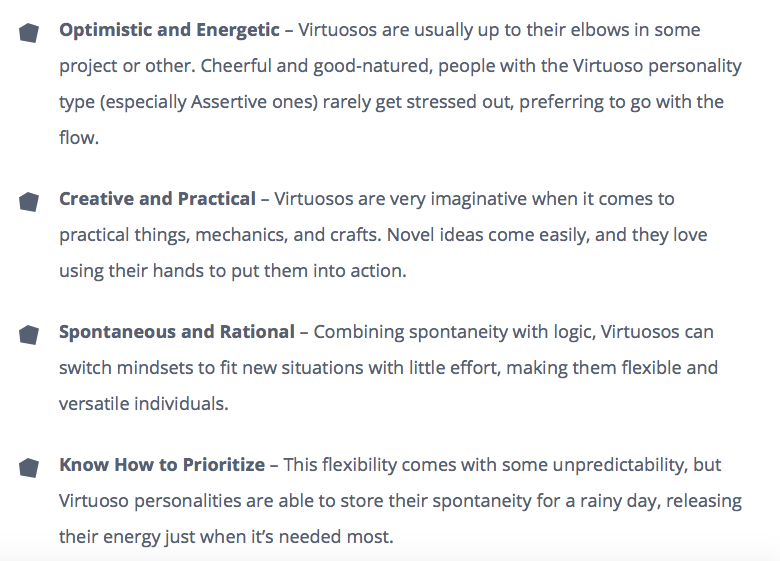
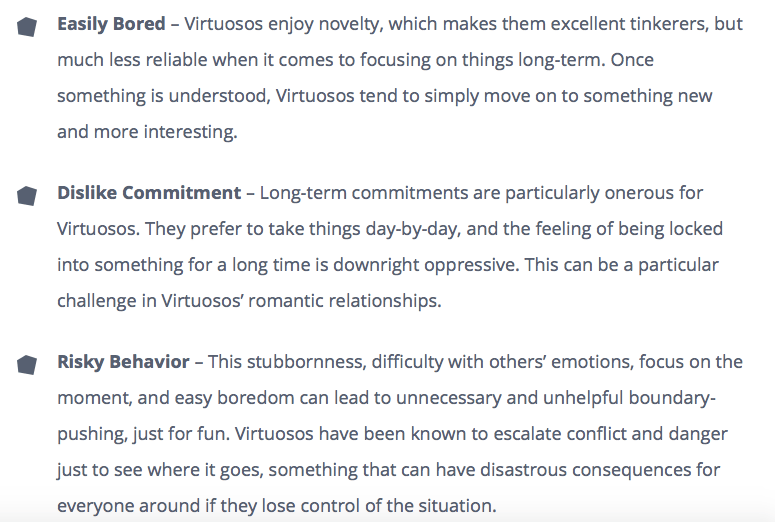
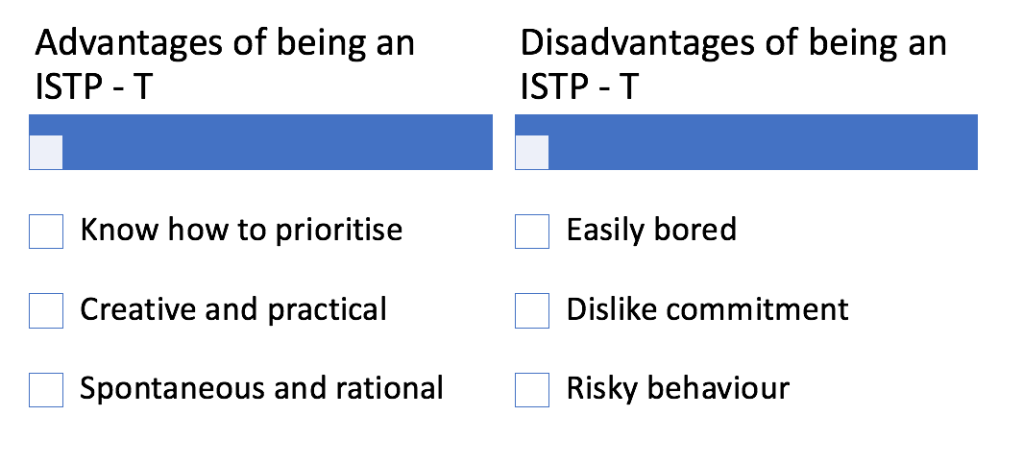
The first part of the test that popped out to me was the fact that I am considered turbulent (at a whooping 99%). According to 16 personalities (n.d), turbulent types are said to be very self conscious, a bit on the perfectionist side of things and also concerned about their abilities. I would say that part suits me really well along with the fact that I am very introverted. This has caused me to really struggle in coming to terms with my injury, blaming myself for what has happened as being careless and stupid to think I would walk away from the Anglesey Half-Marathon unscathed. Lofti et al. (2014) found that patients with bipolar personality disorder (BPD) who blamed themselves for what happened and are less open to the accident resorted to more impulsive behaviour, showing that personality could have an effect on a person’s actions. However, since this is when a person has a personality disorder, this might not be applicable to me as despite having these personality traits, I might react differently to the situation.
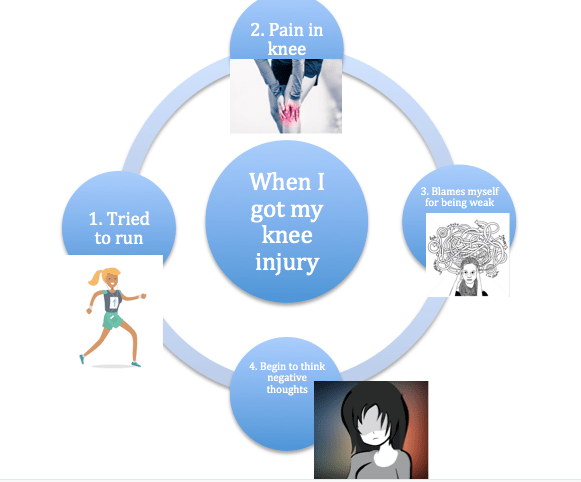
I also had a very hard time dealing with the pain in my knee, which was so painful I couldn’t even sit in a chair for too long or sleep properly because of how much my knee hurts when it moved even slightly. Hudspeth, Rash and Guffey (2020) found that people with ‘feeling’ and ‘judging’ personality types, meaning people who are introverted and like control over their situations have less tolerance to chronic pain, indicating that personality plays a role in pain perception. On the other hand, people with a Harm Avoidance (HA) personality, where they do their best to avoid pain by looking back at past situations where pain may have been involved and coming up with a plan to prevent it from happening again, are more likely to be able to handle pain than the other personality types (Pud et al., 2004). Despite personality playing a role in pain perception, there may also be a possibility of my body just not being used to the pain as I never sustained an injury before, which could mean I just haven’t experienced enough pain to be able to tolerate it instead of it being 100% due to my personality.
So what am I going to do to bounce back from my injury? With the knowledge that I might not be able to run the marathon both because of my injury and the coronavirus going out of hand, there had to be a way to help myself find the motivation to do something. After running for the past three months and letting all that effort going down the drain isn’t something I want to happen and I still plan to run the marathon if I can because it has been a dream goal of mine to fulfill. To achieve this goal, I plan to build up on my grit levels.
Grit plays a very important role in achieving long term goals, where a person has the perseverance and passion to want to fulfill it (Duckworth, Peterson, Matthews, & Kelly, 2007). The marathon is a long term goal that I am halfway to fulfilling, have the perseverance and passion to do so. Hopefully that would be able to keep me going. Grit has also been shown to be important in regulating self-motivation in students in studying, with people who are more gritty doing self-regulated study and doing better in exams as compared to people who are less gritty (Wolters & Hussain, 2015). This showed that self-motivation is an important drive in grit, especially in these times where I have to commit to my training without anyone to guide me or anyone to run with me.
So how do I get more gritty? As passion plays into the concept of grit (Cross, 2014), I thought I might try out a new way of achieving a long term goal by running for the RSPCA. As a fan of animals and the proud owner of a cute little poodle, what better way to motivate myself to run than to run for the animals? After hearing of the ‘Once Upon A Run’ scheme, where you have the entire month of April to run 26.2 miles (the same distance as a marathon), I thought not only would it help me ease myself back into training, but it would also help motivate myself to run as I would be getting a medal at the end of it. Dibert and Goldenberg (1995) found that preceptor nurses were more likely to be more committed to the role when they know that the people they help would be able to get better, showing that knowing a person would be getting a reward can motivate someone to be more committed to their role. However, there is a risk of me not wanting to run anymore because of how long the goal is (an entire month) and with the delayed response to get the reward, it might reduce my motivation (Green, Fry & Myerson, 1994).
However, I don’t think this will happen to me. Even though the reward is far away, I still have the passion for running to raise money for animals so that would not stop me from running. Also, running for a good cause can also help boost happiness in me (Layous et al., 2012). Buchanan & Bardi (2010) found that by carrying out new acts of kindness in a short period of time, a person is able to experience higher levels of happiness, showing that helping others could boost wellbeing. Knowing that I am running for a good cause, not only do I get to clock my milleage, but I am also able to help save the animals, which is a bonus.
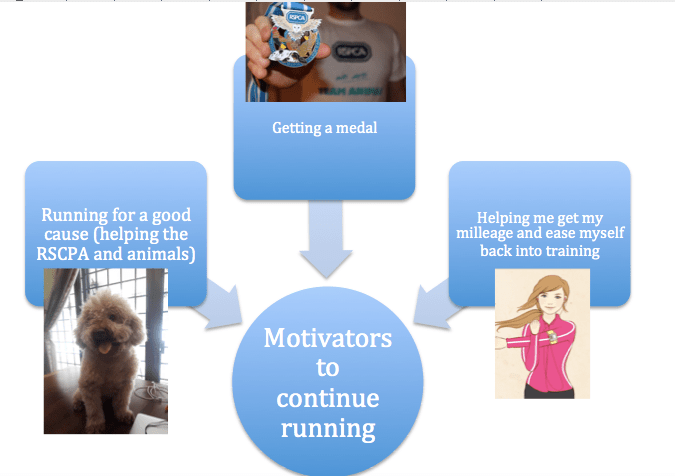
So this is my plan to get back into training. Going to try and see if my knee is up for running in the next few days or week and hopefully, things will turn out well.
Until the next blog, have a great week and stay safe!
References :
16 personalities online test (n.d.). Retrieved from https://www.16personalities.com/istp-strengths-and-weaknesses
Buchanan, K. E., & Bardi, A. (2010). Acts of kindness and acts of novelty affect life satisfaction. The Journal of social psychology, 150(3), 235-237
Capraro, R. M., & Capraro, M. M. (2002). Myers-briggs type indicator score reliability across: Studies a meta-analytic reliability generalization study. Educational and Psychological Measurement, 62(4), 590-602.
Cross, T. M. (2014). The gritty: grit and non-traditional doctoral student success. Journal of Educators Online, 11(3), n3.
Dibert, C., & Goldenberg, D. (1995). Preceptors’ perceptions of benefits, rewards, supports and commitment to the preceptor role. Journal of Advanced Nursing, 21(6), 1144-1151.
Don’t worry, be happy (n.d.). Retrieved from https://www.16personalities.com/articles/the-turbulent-personality-dont-worry-be-happy
Duckworth, A. L., Peterson, C., Matthews, M. D., & Kelly, D. R. (2007). Grit: perseverance and passion for long-term goals. Journal of personality and social psychology, 92(6), 1087.
Green, L., Fry, A. F., & Myerson, J. (1994). Discounting of delayed rewards: A life-span comparison. Psychological science, 5(1), 33-36.
Hudspeth, M., Rash, A., & Guffey, J. S. (2020). Association Between Personality Types and Predilection to Chronic Pain. Journal of Allied Health, 49(1), 69E-72E.
Layous, K., Nelson, S. K., Oberle, E., Schonert-Reichl, K. A., & Lyubomirsky, S. (2012). Kindness counts: Prompting prosocial behavior in preadolescents boosts peer acceptance and well-being. PloS one, 7(12)
McCrae, R. R., Costa Jr, P. T., Terracciano, A., Parker, W. D., Mills, C. J., De Fruyt, F., & Mervielde, I. (2002).
Pittenger, D. J. (1993). The utility of the Myers-Briggs type indicator. Review of educational research, 63(4), 467-488.
Pud, D., Eisenberg, E., Sprecher, E., Rogowski, Z., & Yarnitsky, D. (2004). The tridimensional personality theory and pain: harm avoidance and reward dependence traits correlate with pain perception in healthy volunteers. European Journal of Pain, 8(1), 31-38.
Rawwas, M. Y. (2001). Culture, personality and morality. International Marketing Review.
Specht, J., Luhmann, M., & Geiser, C. (2014). On the consistency of personality types across adulthood: Latent profile analyses in two large-scale panel studies. Journal of personality and social psychology, 107(3), 540.
Stein, R., & Swan, A. B. (2019). Evaluating the validity of Myers‐Briggs Type Indicator theory: A teaching tool and window into intuitive psychology. Social and Personality Psychology Compass, 13(2), e12434.
 Born to run blog