It’s been about a month since lockdown started and everything that was supposed to be normal life came to a halt. The marathon I had been training for has been postponed to October and given the thought that I have no idea where I will be during that time and also if I can even take part in the marathon just makes me wonder if I should even continue to run. My injury hasn’t completely healed either, meaning I can’t even go for a slow jog now.

This is one song I can really relate to right now (never thought I would even want to hear this again considering getting fed up of hearing it on repeat over the radio). I’m so close to just let everything go, dumping my degree onto the ground and just kicking back and trying to forget about life. Not being able to go home, attend classes or even have a vague idea of what my future has in store for me is taking it’s toll on me. I don’t even know when my graduation ceremony would be, making me ponder on whether it is even worth finishing this degree that took three years out of my entire life to complete, only for it to conclude in such a manner.
So, do I let it go or should I soldier on?
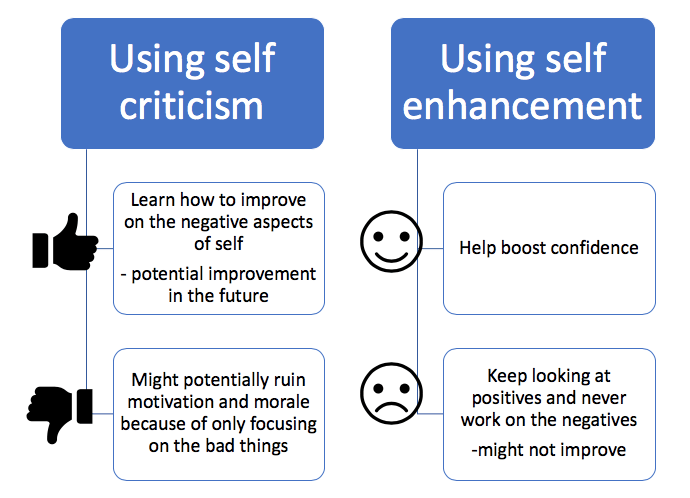
One of the things that really pissed me off about this whole situation is that while I have all this time in my hands to run, I have an injury that doesn’t seem to go away even after a month or so resting at home. Even whilst trying to turn to other activities to help strengthen my body and heal my knee, it doesn’t seem to be working and that in effect was very frustrating. I tend to run myself down with self criticism, which often does more harm to myself since I would focus more on the negatives than on the positives on what I achieved, which could then lead to me feeling helpless about the situation (Blatt, Quinlan, Chevron, McDonald & Zuroff , 1982).
An interesting link was found between the use of self criticism and self compassion in different cultures. Research has shown that often in East Asian countries, people tend to focus more on self criticism than self compassion and vice versa for Western countries (Markus & Kitayama, 1991). This was often due to the fact that East Asian countries mostly consisting of collective contructions of members in a society, where a mistake of a single person could jeopardise that community (Kitayama, Markus, Matsumoto & Norasakkunkit, 1997). To prevent the society from collapsing, it’s members are trained to always be aware of themselves and how their mistakes could possibly affect the community, causing them to evaluate the negatives they had done as compared to the positives. While this could be a good thing in ensuring peace and harmony in the group, it could also lead to members not being able to function psychologically at a 100% due to not being able to focus on the positives that could help enhance self esteem (Heine, 2003).Despite this research, it is hard to truly say whether self criticism is wholly bad or could actually bring benefit to a person as it really depends on how a person is brought up and what their culture expects of them as well as a person’s personality, leading to a variety of possible outcomes if self criticism is used.
From a personal point of view, coming from an East Asian country that does expect you to conform to society’s norms, I may have developed the habit of self criticism a lot more than I should. However, my parents did not instil this particular way of thinking into me, which meant I might have picked it up from school or interacting with the environment around me. One thing I often found myself criticising over is on how things often do not seem to go the way I planned. For example, with my injury, I blamed myself for getting hurt and not being able to continue with my training. On top of that, I don’t even know if I would be around to run the marathon with all the uncertainties for the future, leaving me demotivated and wanting to give up on achieving this goal.

One way I might be able to overcome this is by trying to practice self enhancement, where I focus on the good things I have done in the past to help motivate myself. In that way, I would be able to see that I have actually done something that is worth merit and possibly boost my confidence (Markus & Kitayama, 1991; Yamaguchi, Kim & Akutsu, 2014). For the negatives, I could attribute it to outside causes such as unforeseen circumstances happening on that happen instead of them being entirely my fault. However, taking this and self criticism into consideration, I would rather go with self criticism. While self enhancement strives to look at the positives, I believe always looking at the positive and blaming the bad things that happen to me being out of my control, I would never be able to improve myself in the future. On the other hand, with self criticism, if I evaluate and run myelf down too much, I would be at risk of never being satisfied with what I have and striving towards a goal I can never reach, which could lead to my psychological wellbeing not being able to function at a 100%.
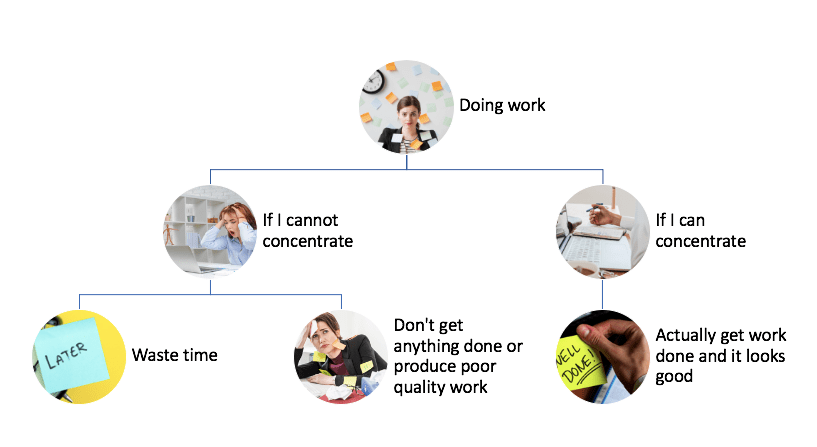
While I would like to just go with the flow of things, I need to have a plan in place in order to get work done. With everything going on, it would be the best thing to just give myself a bit off a breather once in a while and not to judge myself too harshly for not being able to get work done. Not only would I not be able to get work done since I can’t concentrate, I would also possibly be performing worse in producing work, which would then mean that I would have wasted all my time doing something that isn’t worth it (Tuten & Neidermeyer, 2004).
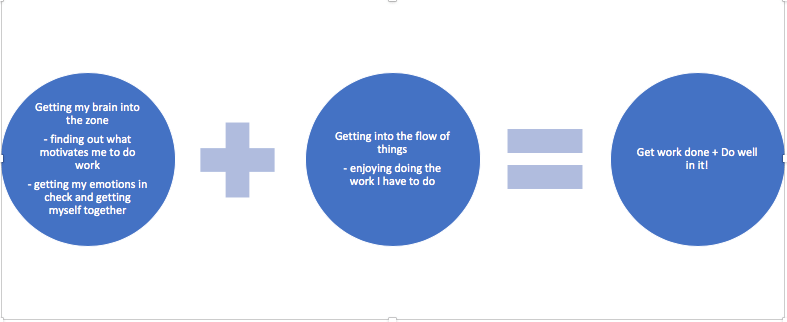
Instead of trying to jump straight into the task when I am unable to concentrate, I should try and get myself into a mindset where I would be able to focus well on a task. This means trying to get into the ‘zone of optimal functioning’, where I get my emotions under control and tune them to the current situation as well as getting my body to adapt to the situation at hand so I don’t become stressed (Kamata, Tenenbaum & Hanin, 2002). According to the IZOF model (Robazza, 2006), if I am able to find out how I can motivate myself to do well in a task and reign in my emotions to handle the situation, I should be able to start doing well in a task. Once in the ‘flow’, where a person is able to perform well in a task when they are in a highly pleasurable state whilst matching to the demands of a task (Payne, Jackson, Noh & Stine-Morrow, 2011), I should be able to work whilst enjoying it.
Another way would be to at least show myself some self compassion, which is the practice of being kind and understanding to oneself when experiencing failure (Barnard & Curry, 2011) . As someone who can be very hard on myself, I should try to treat myself a bit better and not blame myself for not doing enough work since with everything going on, it’s normal to be out of whack and not perform as well as I normally do (not that I am not like that on normal days). Neff, Kirkpatrick and Rude (2006) found that self compassion can help reduce anxiety if faced with a threat and also help improve a person’s psychological wellbeing. However, it is also important to know that while it’s good to be positive, knowing that negative possiblities exist as well can help keep emotions in check in helping motivate oneself to do better and to move forward in life (Diener, 2003). At this moment in time, while I do need to be aware that I would not necessarily perform at my best and so cannot work most of the time, I also need to be aware that despite of all this, I still need to do work and complete my degree and find the motivation to carry on.
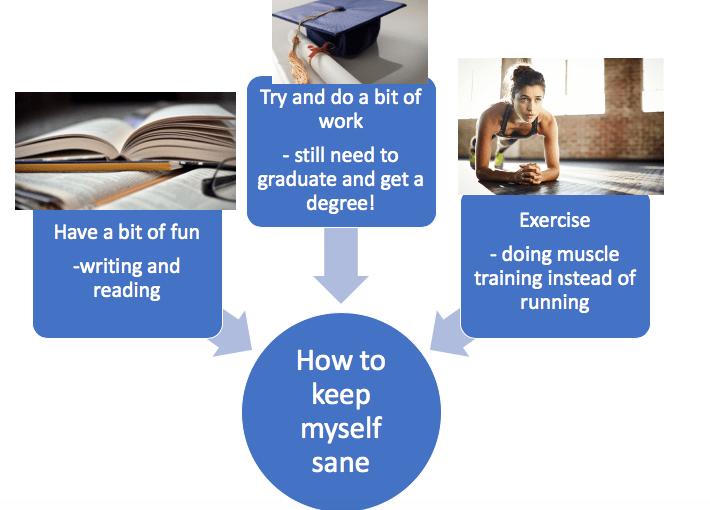
Since I cannot run yet and am in the process of trying to heal my knee, I have taken to practicing some muscle training at home. Even though I am not a fan of those, it’s better than just sitting down and not doing anything. I also take some time out from work and just sit down and read a good book or just enjoy my favourite past time of writing. It has been a while since I wrote something and I even got into trying to write a couple of stories that hopefully would turn out better than I hope. Not only does it help keep me occupied, but it also helps keep my emotions in check and sometimes after writing, I get into the mood of doing my dissertation which helps, since I have to submit it soon.
I also have the support of my lecturers during this hard time, which is really helpful in knowing that I have people who are watching out for me and care about my progress. Social support has been seen to help elevate psychological distress in times of trouble (Hobfall & London, 1986) due to a person being able to interact with other people who emphatise with their situation and help them overcome it. In these times, having contacted my family has helped me get through this even though I am far from home, as well as being able to contact my lecturers when I needed a chat.
While my degree and my participation in the Born to Run module came to a halt way too soon, I am forever grateful to have been able to participate in such a wonderful module. Even if I may not be able to run a full marathon in October, at least I have ran a half marathon, which is a feat on it’s own and accomplished something amazing in my 22 years of life. Its been a crazy year and semester and with my graduation underway, I hope that one day, I will be able to look back at these blogs and think that, yes, I can deal with this.
I can run, I will run, and one day, I will run that marathon.
So will I let it go? No. I will fight on and finish this journey, even with how crazy everything is going.

Thank you for reading this blog and I hope that it helped inspired those of you who read it. Who knows, maybe one day, you might run a marathon too.
Stay safe and thank you for reading this!
References:
Barnard, L. K., & Curry, J. F. (2011). Self-compassion: Conceptualizations, correlates, & interventions. Review of general psychology, 15(4), 289-303.
Blatt, S. J., Quinlan, D. M., Chevron, E. S., McDonald, C., & Zuroff, D. (1982). Dependency and self-criticism: psychological dimensions of depression. Journal of consulting and clinical psychology, 50(1), 113.
Diener, E. (2003). What is positive about positive psychology: The curmudgeon and Pollyanna. Psychological Inquiry, 14(2), 115-120.
Heine, S. J. (2003). An exploration of cultural variation in self-enhancing and self-improving motivations.
Hobfoll, S. E., & London, P. (1986). The relationship of self-concept and social support to emotional distress among women during war. Journal of Social and Clinical Psychology, 4(2), 189-203.
Kamata, A., Tenenbaum, G., & Hanin, Y. L. (2002). Individual zone of optimal functioning (IZOF): A probabilistic estimation. Journal of Sport and Exercise Psychology, 24(2), 189-208.
Kitayama, S., Markus, H. R., Matsumoto, H., & Norasakkunkit, V. (1997). Individual and collective processes in the construction of the self: self-enhancement in the United States and self-criticism in Japan. Journal of personality and social psychology, 72(6), 1245.
Markus, H. R., & Kitayama, S. (1991). Culture and the self: Implications for cognition, emotion, and motivation. Psychological review, 98(2), 224.
Neff, K. D., Kirkpatrick, K. L., & Rude, S. S. (2007). Self-compassion and adaptive psychological functioning. Journal of research in personality, 41(1), 139-154.
Payne, B. R., Jackson, J. J., Noh, S. R., & Stine-Morrow, E. A. (2011). In the zone: Flow state and cognition in older adults. Psychology and aging, 26(3), 738.
Robazza, C. (2006). Emotion in sport: An IZOF perspective. Literature reviews in sport psychology, 127-158.
Tuten, T. L., & Neidermeyer, P. E. (2004). Performance, satisfaction and turnover in call centers: The effects of stress and optimism. Journal of business research, 57(1), 26-34.
Yamaguchi, A., Kim, M. S., & Akutsu, S. (2014). The effects of self-construals, self-criticism, and self-compassion on depressive symptoms. Personality and Individual Differences, 68, 65-70.
 Born to run blog