Be yourself; Everyone else is already taken.
— Oscar Wilde.
This is the first post on my new blog. I’m just getting this new blog going, so stay tuned for more. Subscribe below to get notified when I post new updates.
Be yourself; Everyone else is already taken.
— Oscar Wilde.
This is the first post on my new blog. I’m just getting this new blog going, so stay tuned for more. Subscribe below to get notified when I post new updates.
It’s been about a month since lockdown started and everything that was supposed to be normal life came to a halt. The marathon I had been training for has been postponed to October and given the thought that I have no idea where I will be during that time and also if I can even take part in the marathon just makes me wonder if I should even continue to run. My injury hasn’t completely healed either, meaning I can’t even go for a slow jog now.

This is one song I can really relate to right now (never thought I would even want to hear this again considering getting fed up of hearing it on repeat over the radio). I’m so close to just let everything go, dumping my degree onto the ground and just kicking back and trying to forget about life. Not being able to go home, attend classes or even have a vague idea of what my future has in store for me is taking it’s toll on me. I don’t even know when my graduation ceremony would be, making me ponder on whether it is even worth finishing this degree that took three years out of my entire life to complete, only for it to conclude in such a manner.
So, do I let it go or should I soldier on?
One of the things that really pissed me off about this whole situation is that while I have all this time in my hands to run, I have an injury that doesn’t seem to go away even after a month or so resting at home. Even whilst trying to turn to other activities to help strengthen my body and heal my knee, it doesn’t seem to be working and that in effect was very frustrating. I tend to run myself down with self criticism, which often does more harm to myself since I would focus more on the negatives than on the positives on what I achieved, which could then lead to me feeling helpless about the situation (Blatt, Quinlan, Chevron, McDonald & Zuroff , 1982).
An interesting link was found between the use of self criticism and self compassion in different cultures. Research has shown that often in East Asian countries, people tend to focus more on self criticism than self compassion and vice versa for Western countries (Markus & Kitayama, 1991). This was often due to the fact that East Asian countries mostly consisting of collective contructions of members in a society, where a mistake of a single person could jeopardise that community (Kitayama, Markus, Matsumoto & Norasakkunkit, 1997). To prevent the society from collapsing, it’s members are trained to always be aware of themselves and how their mistakes could possibly affect the community, causing them to evaluate the negatives they had done as compared to the positives. While this could be a good thing in ensuring peace and harmony in the group, it could also lead to members not being able to function psychologically at a 100% due to not being able to focus on the positives that could help enhance self esteem (Heine, 2003).Despite this research, it is hard to truly say whether self criticism is wholly bad or could actually bring benefit to a person as it really depends on how a person is brought up and what their culture expects of them as well as a person’s personality, leading to a variety of possible outcomes if self criticism is used.
From a personal point of view, coming from an East Asian country that does expect you to conform to society’s norms, I may have developed the habit of self criticism a lot more than I should. However, my parents did not instil this particular way of thinking into me, which meant I might have picked it up from school or interacting with the environment around me. One thing I often found myself criticising over is on how things often do not seem to go the way I planned. For example, with my injury, I blamed myself for getting hurt and not being able to continue with my training. On top of that, I don’t even know if I would be around to run the marathon with all the uncertainties for the future, leaving me demotivated and wanting to give up on achieving this goal.

One way I might be able to overcome this is by trying to practice self enhancement, where I focus on the good things I have done in the past to help motivate myself. In that way, I would be able to see that I have actually done something that is worth merit and possibly boost my confidence (Markus & Kitayama, 1991; Yamaguchi, Kim & Akutsu, 2014). For the negatives, I could attribute it to outside causes such as unforeseen circumstances happening on that happen instead of them being entirely my fault. However, taking this and self criticism into consideration, I would rather go with self criticism. While self enhancement strives to look at the positives, I believe always looking at the positive and blaming the bad things that happen to me being out of my control, I would never be able to improve myself in the future. On the other hand, with self criticism, if I evaluate and run myelf down too much, I would be at risk of never being satisfied with what I have and striving towards a goal I can never reach, which could lead to my psychological wellbeing not being able to function at a 100%.
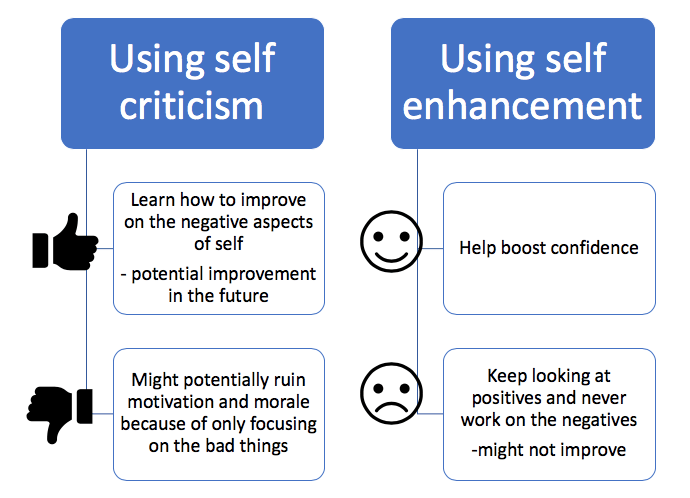
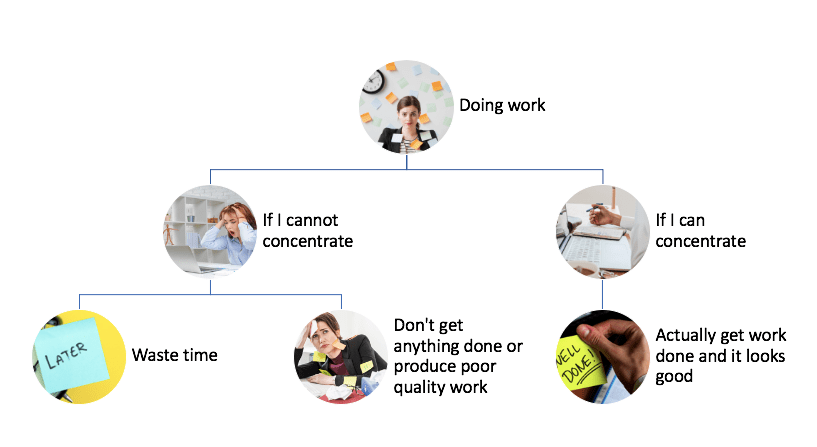
While I would like to just go with the flow of things, I need to have a plan in place in order to get work done. With everything going on, it would be the best thing to just give myself a bit off a breather once in a while and not to judge myself too harshly for not being able to get work done. Not only would I not be able to get work done since I can’t concentrate, I would also possibly be performing worse in producing work, which would then mean that I would have wasted all my time doing something that isn’t worth it (Tuten & Neidermeyer, 2004).
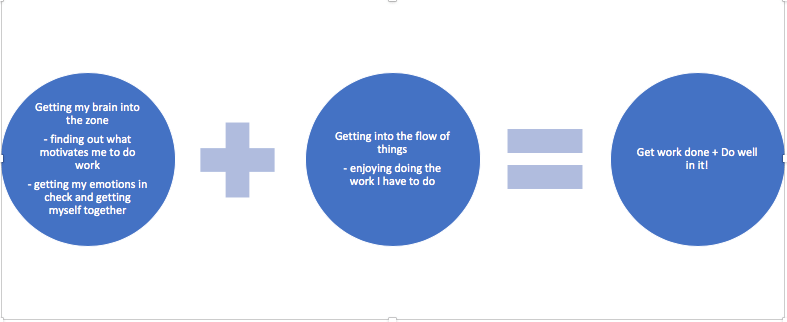
Instead of trying to jump straight into the task when I am unable to concentrate, I should try and get myself into a mindset where I would be able to focus well on a task. This means trying to get into the ‘zone of optimal functioning’, where I get my emotions under control and tune them to the current situation as well as getting my body to adapt to the situation at hand so I don’t become stressed (Kamata, Tenenbaum & Hanin, 2002). According to the IZOF model (Robazza, 2006), if I am able to find out how I can motivate myself to do well in a task and reign in my emotions to handle the situation, I should be able to start doing well in a task. Once in the ‘flow’, where a person is able to perform well in a task when they are in a highly pleasurable state whilst matching to the demands of a task (Payne, Jackson, Noh & Stine-Morrow, 2011), I should be able to work whilst enjoying it.
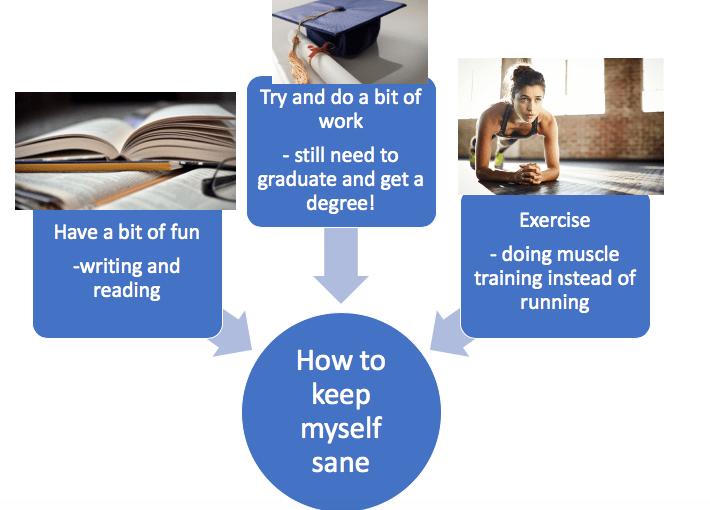
Another way would be to at least show myself some self compassion, which is the practice of being kind and understanding to oneself when experiencing failure (Barnard & Curry, 2011) . As someone who can be very hard on myself, I should try to treat myself a bit better and not blame myself for not doing enough work since with everything going on, it’s normal to be out of whack and not perform as well as I normally do (not that I am not like that on normal days). Neff, Kirkpatrick and Rude (2006) found that self compassion can help reduce anxiety if faced with a threat and also help improve a person’s psychological wellbeing. However, it is also important to know that while it’s good to be positive, knowing that negative possiblities exist as well can help keep emotions in check in helping motivate oneself to do better and to move forward in life (Diener, 2003). At this moment in time, while I do need to be aware that I would not necessarily perform at my best and so cannot work most of the time, I also need to be aware that despite of all this, I still need to do work and complete my degree and find the motivation to carry on.
Since I cannot run yet and am in the process of trying to heal my knee, I have taken to practicing some muscle training at home. Even though I am not a fan of those, it’s better than just sitting down and not doing anything. I also take some time out from work and just sit down and read a good book or just enjoy my favourite past time of writing. It has been a while since I wrote something and I even got into trying to write a couple of stories that hopefully would turn out better than I hope. Not only does it help keep me occupied, but it also helps keep my emotions in check and sometimes after writing, I get into the mood of doing my dissertation which helps, since I have to submit it soon.
I also have the support of my lecturers during this hard time, which is really helpful in knowing that I have people who are watching out for me and care about my progress. Social support has been seen to help elevate psychological distress in times of trouble (Hobfall & London, 1986) due to a person being able to interact with other people who emphatise with their situation and help them overcome it. In these times, having contacted my family has helped me get through this even though I am far from home, as well as being able to contact my lecturers when I needed a chat.
While my degree and my participation in the Born to Run module came to a halt way too soon, I am forever grateful to have been able to participate in such a wonderful module. Even if I may not be able to run a full marathon in October, at least I have ran a half marathon, which is a feat on it’s own and accomplished something amazing in my 22 years of life. Its been a crazy year and semester and with my graduation underway, I hope that one day, I will be able to look back at these blogs and think that, yes, I can deal with this.
I can run, I will run, and one day, I will run that marathon.
So will I let it go? No. I will fight on and finish this journey, even with how crazy everything is going.

Thank you for reading this blog and I hope that it helped inspired those of you who read it. Who knows, maybe one day, you might run a marathon too.
Stay safe and thank you for reading this!
References:
Barnard, L. K., & Curry, J. F. (2011). Self-compassion: Conceptualizations, correlates, & interventions. Review of general psychology, 15(4), 289-303.
Blatt, S. J., Quinlan, D. M., Chevron, E. S., McDonald, C., & Zuroff, D. (1982). Dependency and self-criticism: psychological dimensions of depression. Journal of consulting and clinical psychology, 50(1), 113.
Diener, E. (2003). What is positive about positive psychology: The curmudgeon and Pollyanna. Psychological Inquiry, 14(2), 115-120.
Heine, S. J. (2003). An exploration of cultural variation in self-enhancing and self-improving motivations.
Hobfoll, S. E., & London, P. (1986). The relationship of self-concept and social support to emotional distress among women during war. Journal of Social and Clinical Psychology, 4(2), 189-203.
Kamata, A., Tenenbaum, G., & Hanin, Y. L. (2002). Individual zone of optimal functioning (IZOF): A probabilistic estimation. Journal of Sport and Exercise Psychology, 24(2), 189-208.
Kitayama, S., Markus, H. R., Matsumoto, H., & Norasakkunkit, V. (1997). Individual and collective processes in the construction of the self: self-enhancement in the United States and self-criticism in Japan. Journal of personality and social psychology, 72(6), 1245.
Markus, H. R., & Kitayama, S. (1991). Culture and the self: Implications for cognition, emotion, and motivation. Psychological review, 98(2), 224.
Neff, K. D., Kirkpatrick, K. L., & Rude, S. S. (2007). Self-compassion and adaptive psychological functioning. Journal of research in personality, 41(1), 139-154.
Payne, B. R., Jackson, J. J., Noh, S. R., & Stine-Morrow, E. A. (2011). In the zone: Flow state and cognition in older adults. Psychology and aging, 26(3), 738.
Robazza, C. (2006). Emotion in sport: An IZOF perspective. Literature reviews in sport psychology, 127-158.
Tuten, T. L., & Neidermeyer, P. E. (2004). Performance, satisfaction and turnover in call centers: The effects of stress and optimism. Journal of business research, 57(1), 26-34.
Yamaguchi, A., Kim, M. S., & Akutsu, S. (2014). The effects of self-construals, self-criticism, and self-compassion on depressive symptoms. Personality and Individual Differences, 68, 65-70.
Everything was fine after the half-marathon. Everyone was happy, I was happy and I thought things would remain on Cloud 9, until my knee decided to go on vacation.
Within a week of trying to get back into training, my knee hurt so much that I couldn’t even walk. Walking up and down the stairs was a nightmare, with pain shooting through it at every step and even going to the toilet was painful. I never thought I would get such an injury and when I was feeling the effects of it for the first time, I thought my plans for the marathon had fallen through the roof.
Alongside the whole chaos about the coronavirus spreading across the country, lockdown and the shutting down of the university (what a way to end my undergraduate degree but hey), I had no idea on how I am going to even continue my training. The marathon has been postponed to October and I may not even be in the country then.
The way I approached my injury in the beginning was pretty bad. As someone who hates sitting around and trying to wait for things to get better, I tried to run even though I knew my knee could hurt and I did hurt it really badly afterwards. Taking this into account and considering we learned about how personality could affect someone’s performance in something or how they approached things in life, I thought I might as well try out the 16 personalities online test aka the Myers Briggs test.
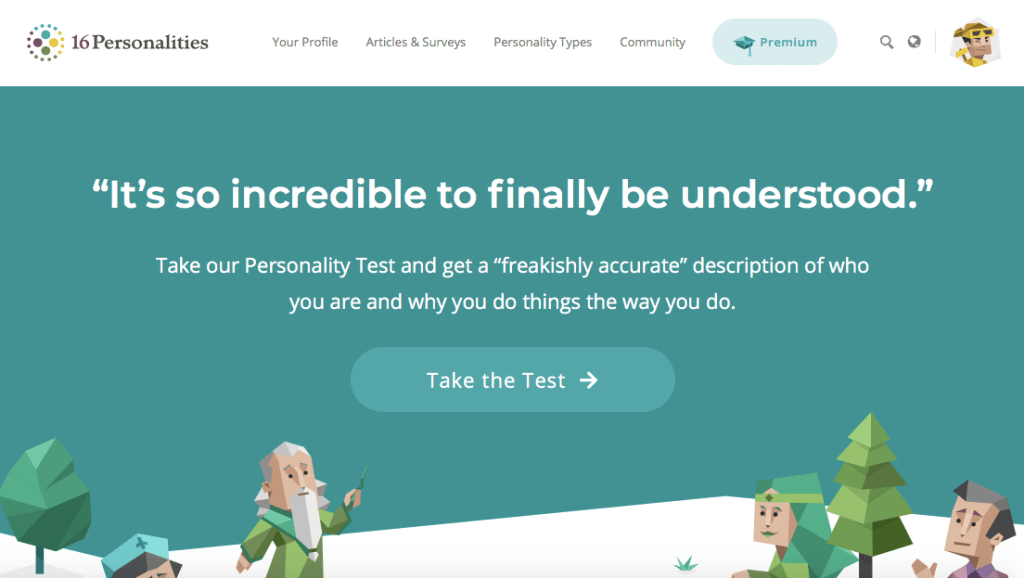
While it has been widely used across the years (Pittenger, 1993), this differs according to different researchers (Capraro & Capraro, 2002; Stein & Swan, 2019) of the research papers analysed. Capraro and Capraro (2002) claimed that the test was valid with high correlation scores, others said the test wasn’t reliable as people are forced to pick between several choices, which could have made them pick an answer that wasn’t quite suitable for them. When I was answering the test, I found that I was answering a lot on the extreme scale of things and there were answers I wasn’t sure of, which could have affected the final outcome of which personality type I was allocated to.
There is also the issue of people’s personality types changing across the years as I recalled that my personality type wasn’t what I had got this time. Some studies found that personality can change across the lifespan, particularly in adolescent years (12 to 18 years old) (McCrae, et al., 2002) and later in life (Specht, Luhmann & Geiser, 2014).Personality may also be affected by where a person lives and the environment they are in as it was found that people who come from cultures of conforming in a group may develop a certain personality type. Being from a certain culture influences how a person’s ethical mannerisms work, showing that being in a certain culture could potentially influence your personality (Rawwas, 2001) After living here in the UK for the past three years and being in a society that is a bit less conforming from my home country, there may be a possibility of me having more freedom to explore myself here, which could have resulted in my personality changing.
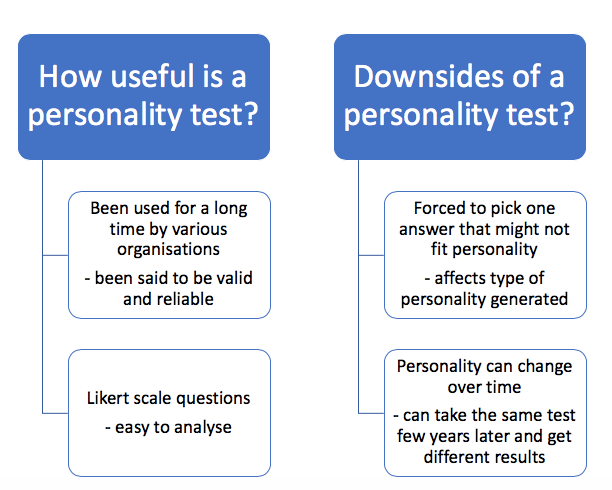
So my results for the personality test is ISTP-T, which is shown in the picture below. While I am taking this test result at face value and not letting it rule out the possibility of my personality being a bit different, I have to agree at what some of my individual traits are and what they stand for.
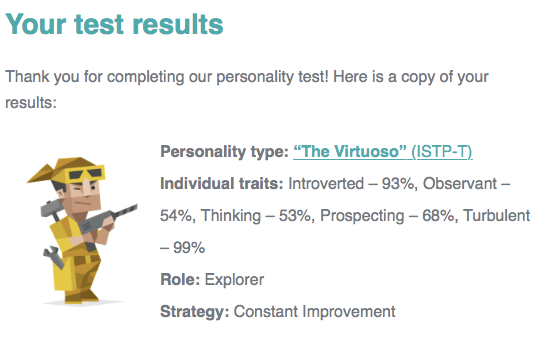
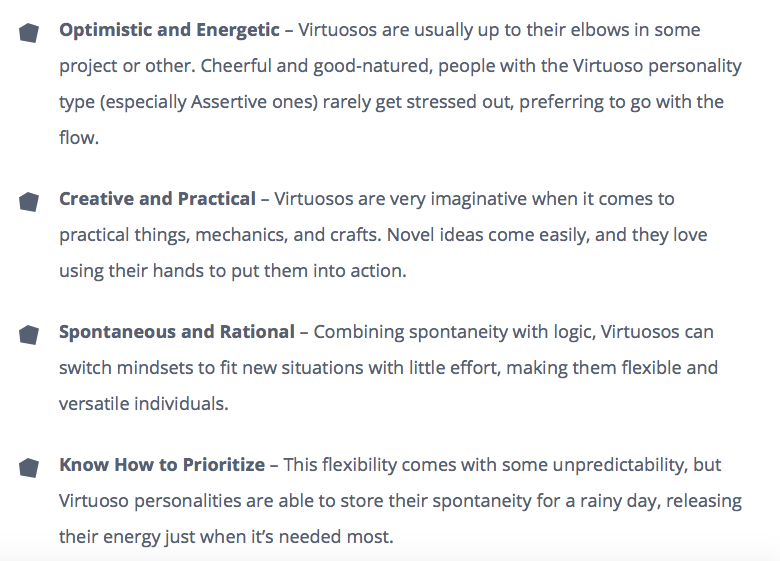
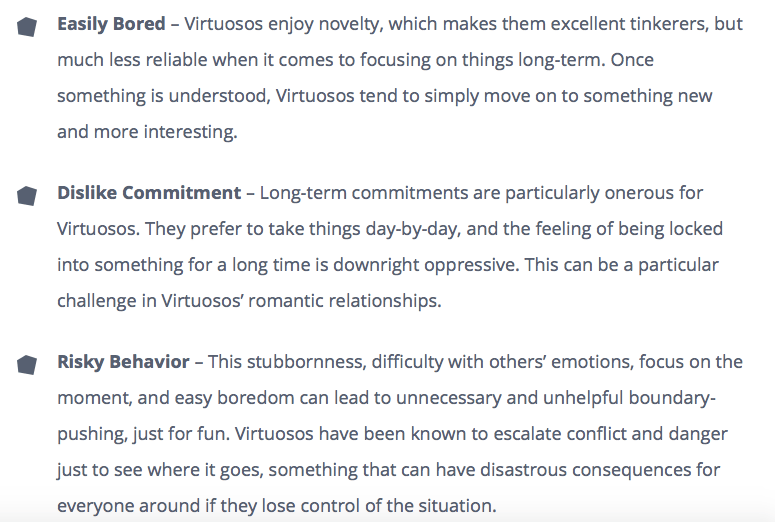
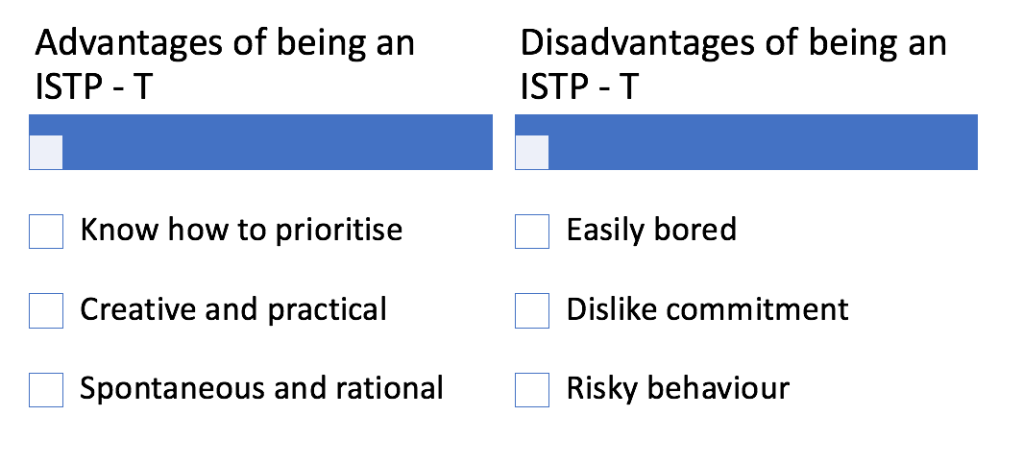
The first part of the test that popped out to me was the fact that I am considered turbulent (at a whooping 99%). According to 16 personalities (n.d), turbulent types are said to be very self conscious, a bit on the perfectionist side of things and also concerned about their abilities. I would say that part suits me really well along with the fact that I am very introverted. This has caused me to really struggle in coming to terms with my injury, blaming myself for what has happened as being careless and stupid to think I would walk away from the Anglesey Half-Marathon unscathed. Lofti et al. (2014) found that patients with bipolar personality disorder (BPD) who blamed themselves for what happened and are less open to the accident resorted to more impulsive behaviour, showing that personality could have an effect on a person’s actions. However, since this is when a person has a personality disorder, this might not be applicable to me as despite having these personality traits, I might react differently to the situation.
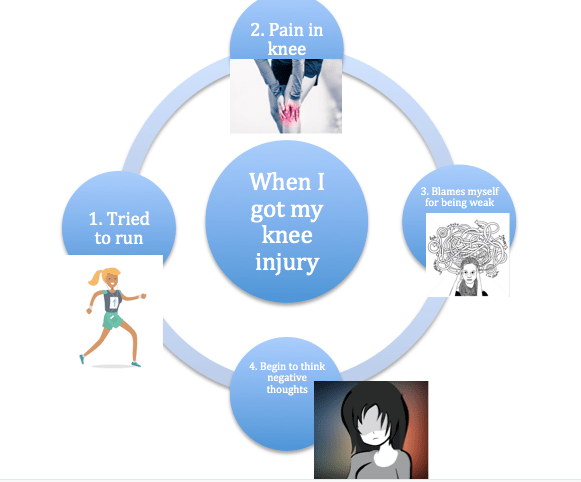
I also had a very hard time dealing with the pain in my knee, which was so painful I couldn’t even sit in a chair for too long or sleep properly because of how much my knee hurts when it moved even slightly. Hudspeth, Rash and Guffey (2020) found that people with ‘feeling’ and ‘judging’ personality types, meaning people who are introverted and like control over their situations have less tolerance to chronic pain, indicating that personality plays a role in pain perception. On the other hand, people with a Harm Avoidance (HA) personality, where they do their best to avoid pain by looking back at past situations where pain may have been involved and coming up with a plan to prevent it from happening again, are more likely to be able to handle pain than the other personality types (Pud et al., 2004). Despite personality playing a role in pain perception, there may also be a possibility of my body just not being used to the pain as I never sustained an injury before, which could mean I just haven’t experienced enough pain to be able to tolerate it instead of it being 100% due to my personality.
So what am I going to do to bounce back from my injury? With the knowledge that I might not be able to run the marathon both because of my injury and the coronavirus going out of hand, there had to be a way to help myself find the motivation to do something. After running for the past three months and letting all that effort going down the drain isn’t something I want to happen and I still plan to run the marathon if I can because it has been a dream goal of mine to fulfill. To achieve this goal, I plan to build up on my grit levels.
Grit plays a very important role in achieving long term goals, where a person has the perseverance and passion to want to fulfill it (Duckworth, Peterson, Matthews, & Kelly, 2007). The marathon is a long term goal that I am halfway to fulfilling, have the perseverance and passion to do so. Hopefully that would be able to keep me going. Grit has also been shown to be important in regulating self-motivation in students in studying, with people who are more gritty doing self-regulated study and doing better in exams as compared to people who are less gritty (Wolters & Hussain, 2015). This showed that self-motivation is an important drive in grit, especially in these times where I have to commit to my training without anyone to guide me or anyone to run with me.
So how do I get more gritty? As passion plays into the concept of grit (Cross, 2014), I thought I might try out a new way of achieving a long term goal by running for the RSPCA. As a fan of animals and the proud owner of a cute little poodle, what better way to motivate myself to run than to run for the animals? After hearing of the ‘Once Upon A Run’ scheme, where you have the entire month of April to run 26.2 miles (the same distance as a marathon), I thought not only would it help me ease myself back into training, but it would also help motivate myself to run as I would be getting a medal at the end of it. Dibert and Goldenberg (1995) found that preceptor nurses were more likely to be more committed to the role when they know that the people they help would be able to get better, showing that knowing a person would be getting a reward can motivate someone to be more committed to their role. However, there is a risk of me not wanting to run anymore because of how long the goal is (an entire month) and with the delayed response to get the reward, it might reduce my motivation (Green, Fry & Myerson, 1994).
However, I don’t think this will happen to me. Even though the reward is far away, I still have the passion for running to raise money for animals so that would not stop me from running. Also, running for a good cause can also help boost happiness in me (Layous et al., 2012). Buchanan & Bardi (2010) found that by carrying out new acts of kindness in a short period of time, a person is able to experience higher levels of happiness, showing that helping others could boost wellbeing. Knowing that I am running for a good cause, not only do I get to clock my milleage, but I am also able to help save the animals, which is a bonus.
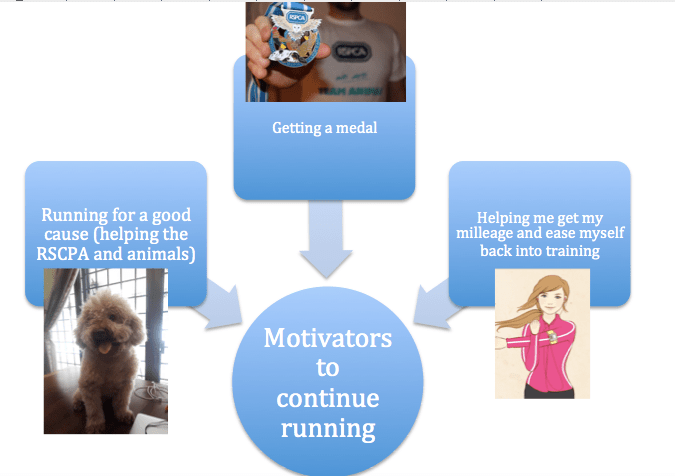
So this is my plan to get back into training. Going to try and see if my knee is up for running in the next few days or week and hopefully, things will turn out well.
Until the next blog, have a great week and stay safe!
References :
16 personalities online test (n.d.). Retrieved from https://www.16personalities.com/istp-strengths-and-weaknesses
Buchanan, K. E., & Bardi, A. (2010). Acts of kindness and acts of novelty affect life satisfaction. The Journal of social psychology, 150(3), 235-237
Capraro, R. M., & Capraro, M. M. (2002). Myers-briggs type indicator score reliability across: Studies a meta-analytic reliability generalization study. Educational and Psychological Measurement, 62(4), 590-602.
Cross, T. M. (2014). The gritty: grit and non-traditional doctoral student success. Journal of Educators Online, 11(3), n3.
Dibert, C., & Goldenberg, D. (1995). Preceptors’ perceptions of benefits, rewards, supports and commitment to the preceptor role. Journal of Advanced Nursing, 21(6), 1144-1151.
Don’t worry, be happy (n.d.). Retrieved from https://www.16personalities.com/articles/the-turbulent-personality-dont-worry-be-happy
Duckworth, A. L., Peterson, C., Matthews, M. D., & Kelly, D. R. (2007). Grit: perseverance and passion for long-term goals. Journal of personality and social psychology, 92(6), 1087.
Green, L., Fry, A. F., & Myerson, J. (1994). Discounting of delayed rewards: A life-span comparison. Psychological science, 5(1), 33-36.
Hudspeth, M., Rash, A., & Guffey, J. S. (2020). Association Between Personality Types and Predilection to Chronic Pain. Journal of Allied Health, 49(1), 69E-72E.
Layous, K., Nelson, S. K., Oberle, E., Schonert-Reichl, K. A., & Lyubomirsky, S. (2012). Kindness counts: Prompting prosocial behavior in preadolescents boosts peer acceptance and well-being. PloS one, 7(12)
McCrae, R. R., Costa Jr, P. T., Terracciano, A., Parker, W. D., Mills, C. J., De Fruyt, F., & Mervielde, I. (2002).
Pittenger, D. J. (1993). The utility of the Myers-Briggs type indicator. Review of educational research, 63(4), 467-488.
Pud, D., Eisenberg, E., Sprecher, E., Rogowski, Z., & Yarnitsky, D. (2004). The tridimensional personality theory and pain: harm avoidance and reward dependence traits correlate with pain perception in healthy volunteers. European Journal of Pain, 8(1), 31-38.
Rawwas, M. Y. (2001). Culture, personality and morality. International Marketing Review.
Specht, J., Luhmann, M., & Geiser, C. (2014). On the consistency of personality types across adulthood: Latent profile analyses in two large-scale panel studies. Journal of personality and social psychology, 107(3), 540.
Stein, R., & Swan, A. B. (2019). Evaluating the validity of Myers‐Briggs Type Indicator theory: A teaching tool and window into intuitive psychology. Social and Personality Psychology Compass, 13(2), e12434.
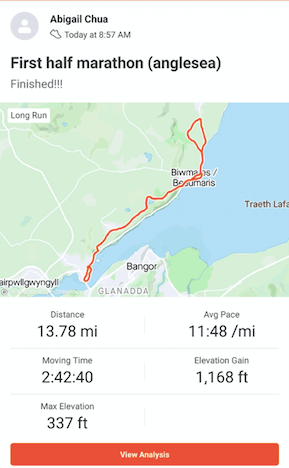
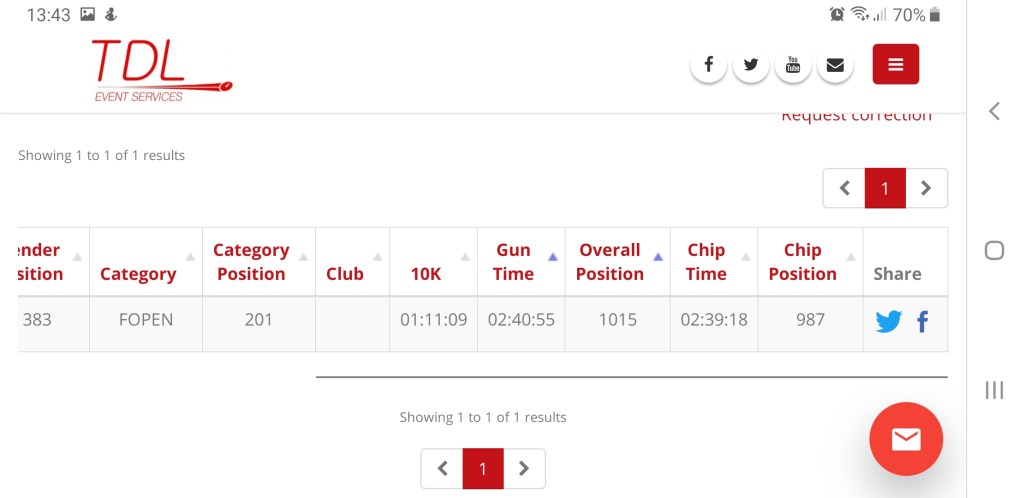
At long last, the Anglesey Half-Marathon came around despite three storms ocuring over the past month or so, with the third one making it across the UK right now. It was freezing, my hips hurt a good few miles until the end, but I managed to finish it and got a pretty medal and cool shirt. I was quite happy with my time considering how much pain I was experiencing during the final leg of the race, which hadn’t happened to me before in the past.
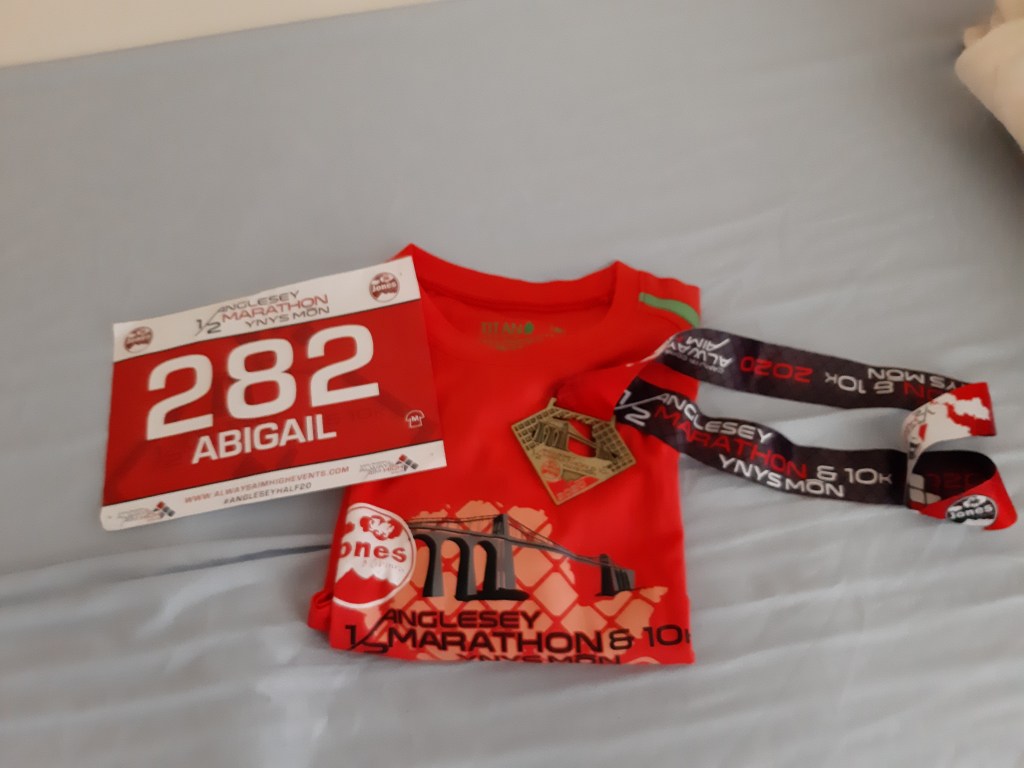
So a few things happened in the race so I will walk through how the race went, more or less in the most detail I can give and make notes on what to do and what not to do in the future.
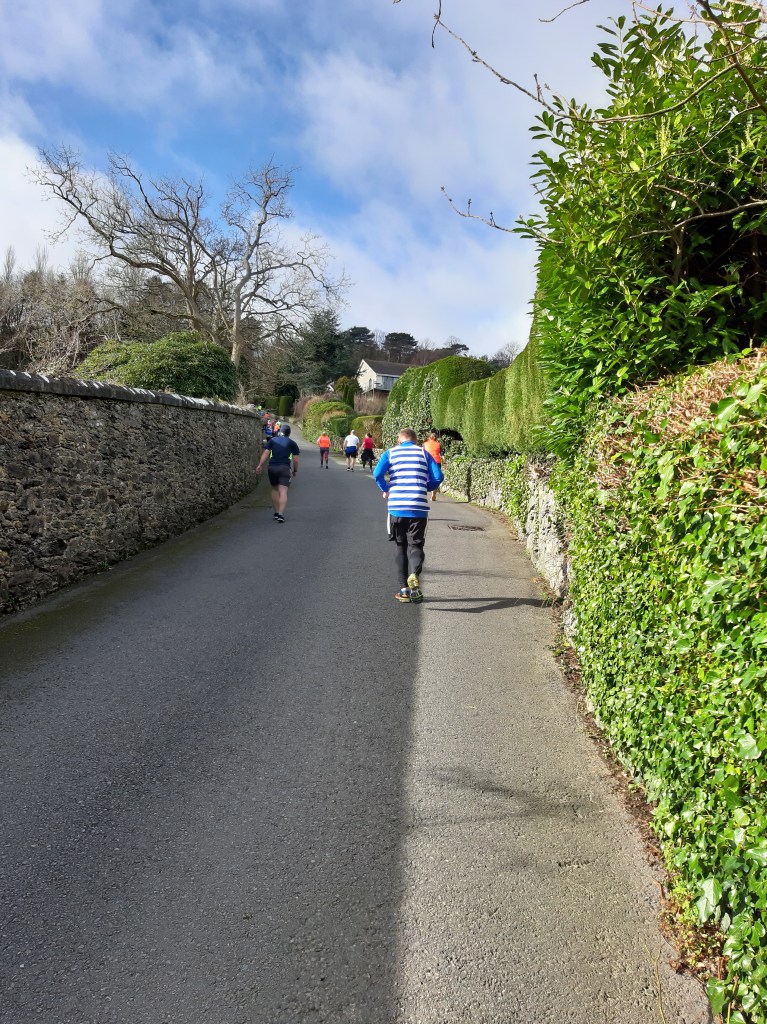
One unexpected thing that happened was a tree falling over the initial race route the night before, causing the organisers to change up the route. What was supposed to be a relatively flat route became a horrible hill right smack in the middle of it along with a few tiny but brutal ones that popped up as we ran back to the finishing line, which was one reason why I found this race pretty hard. Throwing in the fact it is my first race and having to deal with wind and hills, it wasn’t the best combination.
So let’s start off with what went right. I had planned on using music when I was running and since I was running alone (I stupidly forgot to register my brother for the race, thinking I had done so only for me to realise the night before I haven’t), it really helped me when I was running through hard parts of the course. Music has been said to help with dealing with body pain and stress levels by distracting a person’s thoughts from the source of pain and making them focus on something else (North & Hargreaves, 2009). This is because music is a form of dissociative technique, where a person would focus on something other than the task in front of them (Masters & Ogles, 1998). Music that a person choses also has an impact in how they perceive pain, with a study conducted on patients who had undergone surgical treatment showing that those who listened to music of their own choosing often found their feelings towards pain to be less (MacDonald et al., 2003).
Types of music also play a role in how a person may perform in running. Certain types of music such as rap and rock music can result in higher stress levels and increased risk of suicide (North & Hargreaves, 2006). However, it is more important to take into consideration of the lyrics sung in a song that may influence negative behaviour (North & Hargreaves, 2005). On the other hand, inspirational music was found to increase performance in atheletes (Lane, Devis & Devonport, 2011), with atheletes having more positive feelings when running. During the race, I used a mix of inspirational and calming music such as background music from anime and movie scenes which did actually help the pain in my legs reduce when I was feeling tired out as well as giving me a bit of company during the run.
One of the things I thought would help me during the race would be my brother’s presence next to me. Running with another person has been shown to actually help a person run better by increasing the calmness in them (Plante & Ford, 2001) through the social support provided by the other person (Gurung, Sarason & Sarason, 1997). However, this might be affected if the runner is familiar with the other person. However, Plante and Ford (2001) did make a note on familiarity with another person possibly playing a role in a person performing well when exercising with another person, although I am unable to find research regarding this matter at the moment.
The interesting thing was that even though I hardly talked to anyone, when we reached the stage of having to climb the hill to get to the finishing line, people began to randomly chat to each other. I managed to chat with a lady about 50 years older than me (I have to salute her for doing this gruesome half marathon) about how insane the route was and I did feel comfortable talking to her despite her being a stranger.
Talking to a stranger, as daunting as it seems, can actually bring about some benefits to a person. A study found that just by making small conversation with a barista in Starbucks led to people feeling more positive and had a better experience in Starbucks (Sandstrom & Dunn, 2013). The authors explained this as due to the person having a better sense of belonging by interacting with their environment via social interactions that make them feel as part of the environment. Both me and the lady were runners in this race and by talking to her, I felt that I finally had someone who understood the pain my body and mind was going through at that point, which allowed me to feel like I belonged to this group of people racing to get to the finish line.
However, while talking to a stranger in a running context is often seen as alright, sometimes other situations may not yield the same results. First year college students reported that when they found it difficult talking to other new students in their first few weeks of college, especially when they did not have the same interests (Goldstein, 2018). Without a common topic to link two people together, this leads to feelings of isolation in these individuals, resulting in them finding it harder to make new friends as they isolate themselves from others. Therefore, while talking to strangers can have benefits, it really depends if they have the same goals or maybe same topics of conversation as you do in order for it to really work.
| Plan for the run | What worked | What didn’t work | Outcomes |
| 1. Run with brother | Chatted a bit with other runners during the race | Forgot to register my brother so had to run alone | – Felt a bit better – Felt I wasn’t alone in this |
| 2. Listening to music on my IPod | – felt calmer – took mind off pain in hips and legs – could run better by feeling more focused | – battery on IPod nearly ran out – wind was very strong at some points so could barely hear the music | – could take my mind off the pain – managed to run more calmly |
| 3. Eating right | – didn’t have any stomach aches – could run better | – no comment | – eat a good breakfast before half-marathon or long runs over 13 miles |
So after taking these things into consideration and using them to help myself pull through the race, I managed to finish my first ever marathon and the feeling of finishing it is just amazing. With the help of music, the presence and words of encouragement of my fellow runners, I managed to complete this amazing race. Despite having a badly aching body, especially my knees right now, I would love to do another half-marathon in the future. Although I’m not sure if I would ever do Anglesey Half-Marathon again.
Very proud of my time as well and hopefully, I will be able to improve it in the future.
Now that I have completed the half-marathon and this blog, I’m going to have a nice meal and a good night’s sleep (but not before having a binging session of some anime).
Until the next blog, have a great week and stay tuned for more of my running blogs!
References :
Goldstein, H. (2018). Hello Stranger, Will You be my Best Friend.
Gurung, R., Sarason, B., & Sarason, I. (1997). Close personal relationships and health outcomes: A key to the role of social support. Handbook of personal relationships: Theory, research and interventions (2nd ed) Chichester, UK: Wiley, 547-573.
Lane, A. M., Davis, P. A., & Devonport, T. J. (2011). Effects of music interventions on emotional states and running performance. Journal of sports science & medicine, 10(2), 400.
MacDonald, R. A., Mitchell, L. A., Dillon, T., Serpell, M. G., Davies, J. B., & Ashley, E. A. (2003). An empirical investigation of the anxiolytic and pain reducing effects of music. Psychology of Music, 31(2), 187-203.
Masters, K. S., & Ogles, B. M. (1998). Associative and dissociative cognitive strategies in exercise and running: 20 years later, what do we know?. The Sport Psychologist, 12(3), 253-270.
North, A. C. and Hargreaves, D. J. (2005). Labelling effects on the perceived deleterious consequences of pop music listening. Journal of Adolescence, 28, 433-440.
North, A. C., & Hargreaves, D. J. (2006). Problem music and self-harming. Suicide & Life – Threatening Behavior, 36(5), 582-90.
North, A., & Hargreaves, D. (2009). The power of music. The Psychologist, 22(12), 1012-1014.
Sandstrom, G. M., & Dunn, E. W. (2014). Is efficiency overrated? Minimal social interactions lead to belonging and positive affect. Social Psychological and Personality Science, 5(4), 437-442.
It is a cold Tuesday morning, a couple of days after Storm Dennis had swept across the UK. A bunch of us are standing on the track at Treborth, shivering as we did a couple of drills before the rain decided to pay us a little visit when we finally finished doing the drills and began to head back to the cars. Luckily for us, we had come in cars and didn’t have to run back in the rain but the cold was enough to make me feel like my hands would fall off and that I was probably going to freeze to death.
My first half-marathon, the Anglesey Half Marathon, is less than two weeks away and I spend most of my time thinking if I am prepared enough and how I needed to get ready for it, both physically and mentally. After having a couple of lectures on how to get ready for it as well as having my preparations for the half-marathon, I thought I might share a few of my thoughts on the subject.

The furthest race I have run is 10km. Back then, it seemed like a feat but now I feel like it isn’t much compared to what I have to do next week. After hearing horror stories of how bad the weather had been these past few years and the possibility of having to climb a hill midway in the race, I feel my knees go weak. There was also the prospect of possibly not being able to make the cutoff point and having to be escorted back, which makes me scared of both not being able to finish it and possibly having a bit of public humiliation. This week’s long run of 10km was tough and I felt like I would collapse during it, making me wonder if I even have the strength to run the half-marathon. The fear of failure is so crippling, it has prevented me from doing so many things throughout my life, and running is no exception.
Fear can be both a good thing and a bad thing. Sometimes fear is there to keep you from doing something stupid, other times it prevents you from doing something that might get you further in life (Martin & Marsch, 2003). I have fear for a lot of things, especially after having a string of failures in the first month of the year beginning; I broke my washing machine door and have to pay £80 for repairs, flunked three internship interviews, failed an important exam and the list goes on. With the half-marathon being something that will be seen by many people and something I have told friends and family I am going to do, I have a fear of letting people down in the process as well as letting myself down.
Even as I have been reminded over and over that I have achieved things in life and to have confidence in them, I can’t help but feel bogged down by the setbacks that had happened to me, which confirms some of my doubts on whether I am capable of achieving things in life. Martin and Debus (1998) found that students who had doubts in their abilities along with having fears of how they were perceived by the crowd performed worse than those who believed in themselves. While it is good to have confidence, however, if a person is overconfident, this may lead to them performing worst in a situation (Moore & Healy, 2008). I’m a sucker for always doubting myself in everything and believing that I am a loser when something goes wrong, sitting in the corner sobbing and wishing I could curl into a ball and disappear, but I cannot do the forever since I am going to graduate soon and get a job.
Well, as my parents have always told me, there’s no use sitting around and moping when I can do something about it. I can self-determine what happens to myself for the next few weeks. Self-determination is a theory where people are motivated to carry out a goal without having an external motivator that is making them do it. According to Gagne and Deci (2005), there are two types of motivation that may bring about self-determination that is important to distinguish; autonomous motivation and controlled motivation. Autonomous motivation is when a person carries out an activity out of their own free will, to experience something new while controlled motivation is when a person feels obliged to carry out an activity.
In my case of running, I chose to take part in Born to Run and am lucky to be one of the 22 lucky souls to have been able to make it onto the program. Therefore, I chose to take part in the module (although I had to leave it to Lady Luck and hoped the random generator program chose me for the program after putting in my module choices) so I am currently motivated to run. However, I could also say I might be obliged to take part in the half-marathon because most of my classmates are doing so and if I didn’t do so, I might have to do another half-marathon on my own and my lecturer had recommended us to do so months before. Whatever kind of motivation is motivating me to run right now, I have to stay focused in making sure I prepare myself for the half marathon, and I think I might have a few ideas to help me with that.
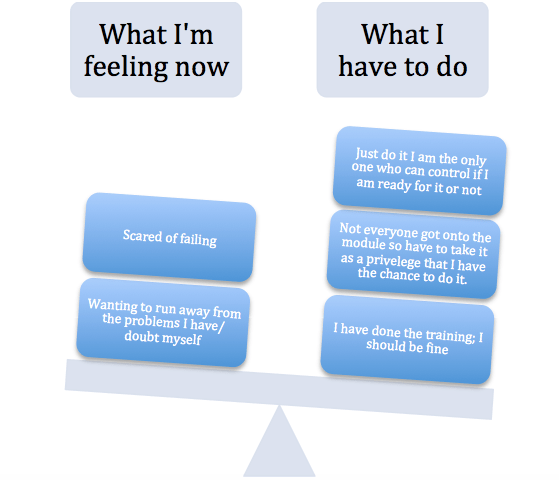
So how do I get myself prepared for the half marathon? Well, one of the things that have been keeping me going this entire time whenever I go running is music, so I’m going to go download some good songs into my iPod and listen to them as I run. Music is a form of dissociative technique, where the person focuses on something else asides from the task they are doing (Masters & Ogles, 1998). Highly motivational music has also been shown to increase performance in exercise, along with helping runners to have more pleasant emotions when running (Lane, Devis & Devonport, 2011).
Whenever I’m on a run and don’t feel like I am getting anywhere and my energy levels are running low, all I need to do is to turn on some music from my favourite anime and imagine myself being whisked off into another world and before I know it, my run is almost over and I feel pumped from having listened to music from epic battle scenes. An interesting study found that inspirational music resulted in participants running slower as compared to when listening to rock or dance music (Tenenbaum et al., 2004), which is funny as I find that inspirational music is the one that keeps me going. However, there have been times where after listening to inspirational music, I did in fact run slower, even losing the motivation to run, so I will try not to use inspirational music unless necessary.
However, listening to music is also said to impair the running experience as a person does not take in their surroundings as much as they should and it might even lead to a person getting involved in accidents when they are not aware of what is going on around them (Grater, 2020). Another technique used by runners, especially elite runners, is the associative technique, where they would focus on all aspects of their body that would affect their performance. However, this would often cause a person to feel more tired as they spend more energy focusing on each aspect of their body and this leads to mental fatigue along with not helping in improving motivation when running (Johnson & Siegel, 1992). This is a little bit of an ongoing debate on whether we should use music when running but since I am not a professional runner and just want to focus on have a good time doing the half marathon, I’m going to stick with my tunes for the timebeing.
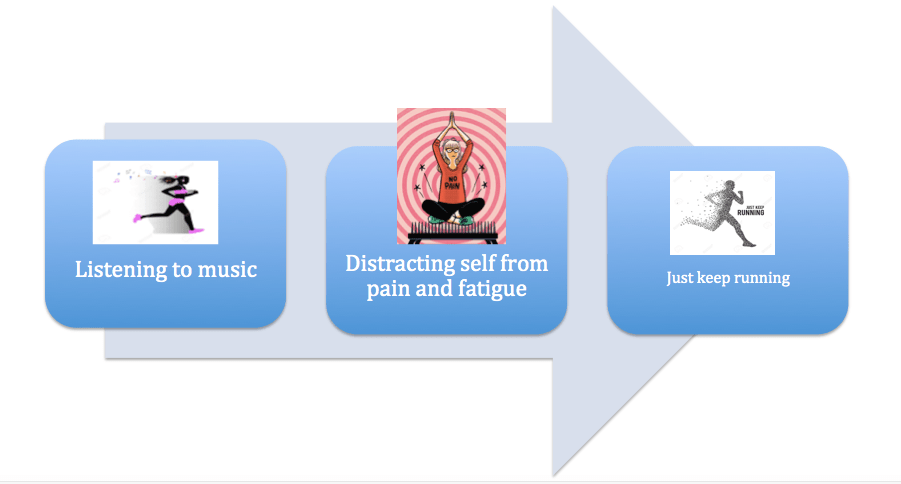
Another interesting thing that I am going to use for the half-marathon that was pointed out by my lecturer during our weekly lectures is the idea of us being the protagonist of our own lives. Most of the heroes we know today such as The Avengers, the Jedi from Star Wars and the list goes on, all went through various stages in their lives where they could have just given up but they didn’t. Instead, they persevered, going through all the hardships, working to overcome them until they finally come up top. Heroes inspire us because of the will and determination they show in overcoming adversities and motivate us to become a better person through witnessing their deeds (Kinsella, Ritchie & Igou, 2015). (Veen, 1994) describes a hero as someone who breaks through their barriers and difficulties in life. I may not be a hero or feel I am the main character of my own life, but there are some aspects of heroes that do apply to me in my life that I can relate to my running journey.
For my running journey, the difficulty is having to train for a marathon in such a short amount of time, without much experience and having to overcome barriers of laziness and injuries to finally make it to the finish line. While not all heroes make it in the end, most do and when they finally defeat the villain in their story, their victory is celebrated as they walk home to family and friends who welcome them with open arms. A little fun fact about me; my running heroes are my parents, especially my dad who got me into running as a kid and one day, I vow to be able to run a marathon with him and maybe even do a triathlon with him. Even though I may not be doing the Liverpool Rock & Roll Marathon with him, I hope that even though he is halfway across the world, he can be assured that I will cross the line and tell him at the end of it that I have accomplished my goal.
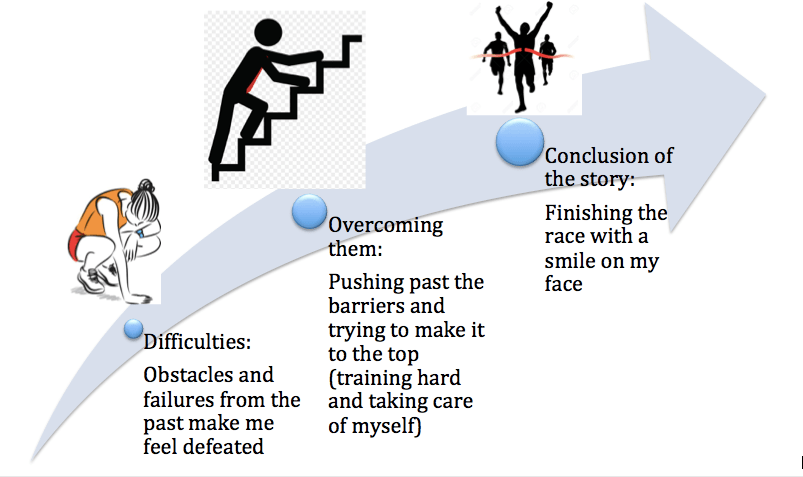
Despite all the things that had happened to me in the past, they still shaped me to who I am today. As much as I want to forget some things that have happened, they will always be part of me and I will continue to hold onto them as I run for the finish line during the Anglesea Half and finally, at the Liverpool Rock & Roll marathon.
Just to end this blog, I’m going to leave a quote from one of my favourite anime, where the main character is born in a world where Heroes are a thing and people have superpowers. While he wasn’t born with any superpowers, through perseverance and hard work, he finally managed to achieve his dreams and is now on an amazing journey with his friends to become the top hero. This quote has inspired me for a long time and I hope it inspires those of you who read this blog too.

Wish me luck in the Anglesea Half-Marathon and until you hear from me again, have a good week.
References:
Deci, E. L., & Ryan, R. M. (2008). Self-determination theory: A macrotheory of human motivation, development, and health. Canadian psychology/Psychologie canadienne, 49(3), 182.
Gagné, M., & Deci, E. L. (2005). Self‐determination theory and work motivation. Journal of Organizational behavior, 26(4), 331-362.
https://www.runnersworld.com/gear/a20799208/should-you-listen-to-music-while-running/
Johnson, J. H., & Siegel, D. S. (1992). Effects of association and dissociation on effort perception. Journal of Sport Behavior, 15(2), 119.
Kinsella, E. L., Ritchie, T. D., & Igou, E. R. (2015). Lay perspectives on the social and psychological functions of heroes. Frontiers in psychology, 6, 130.
Lane, A. M., Davis, P. A., & Devonport, T. J. (2011). Effects of music interventions on emotional states and running performance. Journal of sports science & medicine, 10(2), 400.
Martin, A. J., & Debus, R. L. (1998). Self‐reports of mathematics self‐concept and educational outcomes: The roles of ego‐dimensions and self‐consciousness. British Journal of Educational Psychology, 68(4), 517-535.
Martin, A. J., & Marsh, H. W. (2003). Fear of failure: Friend or foe?. Australian Psychologist, 38(1), 31-38.
Masters, K. S., & Ogles, B. M. (1998). Associative and dissociative cognitive strategies in exercise and running: 20 years later, what do we know?. The Sport Psychologist, 12(3), 253-270.
Moore, D. A., & Healy, P. J. (2008). The trouble with overconfidence. Psychological review, 115(2), 502.
Tenenbaum, G., Lidor, R., Lavyan, N., Morrow, K., Tonnel, S., Gershgoren, A., … & Johnson, M. (2004). The effect of music type on running perseverance and coping with effort sensations. Psychology of sport and exercise, 5(2), 89-109.
Veen, S. V. (1994). The consumption of heroes and the hero hierarchy of effects. ACR North American Advances.
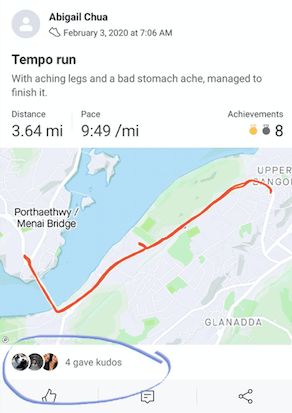
Its seven in the morning, its dark out and its freezing cold, close to zero degrees outside. I yawn as I put on my gear and go out running, only to be plagued by a horrible stomach ache as I crossed Menai Bridge that lasted me the whole run back home. On the bright side, that allowed me to run much faster then I normally would on a tempo run, my brother even gawking at me at how I managed to increase by speed from 8km per hour to 12km per hour.
It’s the third week of the semester, with 14 weeks left (if my maths is correct) until the marathon, with just a little under 4 weeks until the Anglesea half marathon and I’m beginning to feel very worn out, both mentally and physically. My body aches, my mind is screaming that I need some time out and stay at home, reflect on whether I am actually mad trying to do this.
Let’s start off with the main reason why I wanted to do this in the first place : I wanted to be able to tell people I did a marathon, to be able to at least have done something my friends or people I know haven’t done before, to stand out from the crowd. This is what is called extrinsic motivation , where a person does something to get a distinct reward.
In my case, I want acceptance from people, for people to acknowledge I might be able to do something. I have had a history of having low self esteem and always having the need for people to accept me by trying to do things that I normally wouldn’t have done. Pyszczynski, Greenberg, Solomon, Arndt, and Schimel (2004) suggested terror management theory, where a person yearns for self esteem to protect themselves from a world that is dangerous and they need everything in their power to survive in it. Essentially, that is how I feel; having to survive in a world that demands the survival of the fittest, leading to me trying to go above and beyond to stand out from the crowd. Crocker and Knight (2005) pointed out that by basing out lives on contingencies of self worth, this may lead to detrimental consequences such as intense emotion such as self blame when not being able to achieve a goal, poorer health and taking risky behaviours. This could explain why at certain times, even though I might feel my legs about to break, with a storm brewing in the distance or having cramps, I still try to push myself to the limit even though I know there is a risk of me getting injured (or just feeling like crap).
However, that doesn’t mean I don’t enjoy running. I do enjoy running, which means my actions are intrinsically motivated to some degree, where I do have a bit of curiosity in trying to see my limits in a sport I never tried out seriously before. Covington and Mueller (2001) describe the reward paradigm of intrinsic motivation as finding joy in achieving something out of the ordinary and engaging in it because they want to. For me, I find running fun since I did some running in school and with my parents and now that I have the chance to do this module so few people manage to get into, I want to see if I can do it and if I can somehow change my life in the process as I go along with the training and classes.
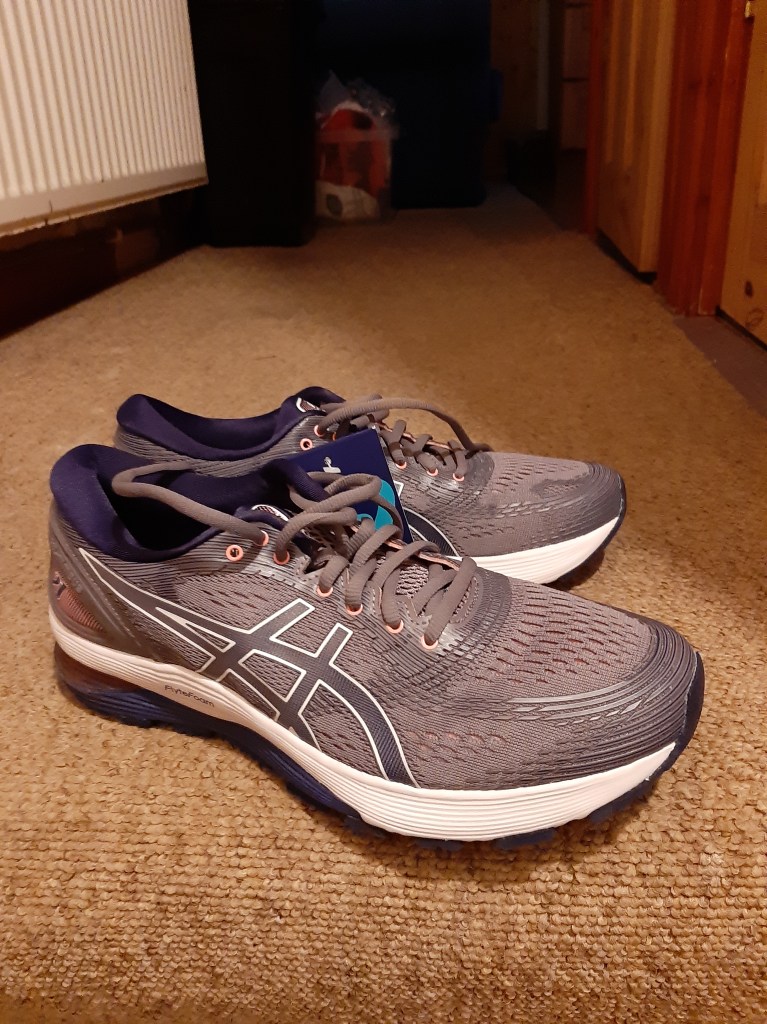
So what has class taught me about how to motivate myself? First thing I have to do is try and create a habit of running for myself. A habit is an action that is triggered by automatically to a cue associated with a person’s routine or performance. It does take time to form a habit, as shown in a study by Lally, Van Jaarsveld, Potts and Wardle (2010) where it took from 18 days even up to 284 days for a habit to form, although missing a few days did not really affect whether the habit would be broken or not. Aarts and Dijksterhuis (2000) suggested that by creating an environment where the habit would be easier to perform, it would result in the habit being carried out more easily. For running, if my running shoes were to be put close to the door, it would make it easier for me to access my shoes for running first thing in the morning.
With these thoughts in mind, here is a little diagram I made for my plan to actually put all of this together and how to create a running habit.
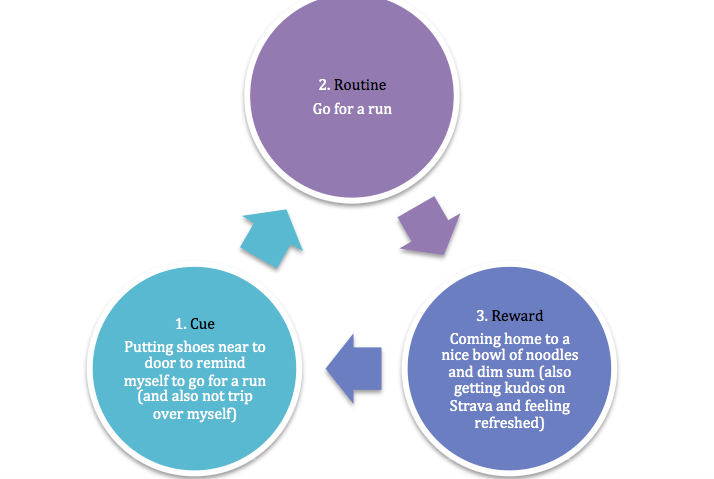
Also, its also a good thing to reward yourself once in a while when you do something (like running 14km on a Saturday morning when you can be asleep). Food is a good motivator for me; I like to have a nice bowl of Spicy Korean Noodles with some dim sum and eggs for breakfast once I finish my run. Its also nice to have people giving ‘kudos’ on your Strava whenever you do a run; it makes you feel good (especially one where you had a bad stomachache and thought you were seriously going to spill your guts on the road).
However, what happens if these rewards stop coming in? Would I still want to run if I run out of noodles to eat, if no one gives me ‘kudos’ on Strava because they got bored of following my progress? Or, what happens if I keep getting these rewards every week? Will they still serve as a good motivator to me or might they actually lead to me not wanting to run even more?
This phenomenon, known as the hedonic treadmill happens when a person grows accustomed to the rewards they received to the point that it becomes normal to them. This means that if I keep eating the food I use as a reward every time I go for a run for a long period of time, it may eventually reach a point where I don’t even feel rewarded eating it and this might demotivate me . However, it is important to distinguish between two kinds of rewards that come into play in this concept; hedonia and eudaimonia. Waterman (2007) described hedonia as pleasure and doing something fun (positive effect) while eudaimonia is all about trying to see the bigger picture and trying to achieve something more (learning from the experience). In Turban and Yan’s (2016) study, both have been shown to be important in the workplace, where people with more hedonistic values tended to love their job more while people with higher eudaimonia levels exhibit attitudes that may help them in the long run of their career.
So how does it apply to my running? In terms of looking at it from a eudaemonic perspective, I should see the running as a way for me to become healthier in the long run, maybe have something interesting to say to interviewers in the future and to also be able to end my undergraduate life on a high note. From the hedonistic perspective, it isn’t all the time I get to run a marathon for a module with other people so I should take this opportunity to just have fun running it and enjoying myself. I don’t know if I may ever have this opportunity in the future so I should just enjoy the moment and have fun.
Let’s hope this plan comes into play and that I would be able to get myself motivated into running once more (while I am running three to four times a week, I feel I’m not doing enough).
Until the next blog, peace out and please continue to watch and support me in my journey through this module.
References:
Aarts, H., & Dijksterhuis, A. (2000). Habits as knowledge structures: Automaticity in goal-directed behavior. Journal of personality and social psychology, 78(1), 53.
Covington, M. V., & Müeller, K. J. (2001). Intrinsic versus extrinsic motivation: An approach/avoidance reformulation. Educational psychology review, 13(2), 157-176.
Crocker, J., & Knight, K. M. (2005). Contingencies of self-worth. Current directions in psychological science, 14(4), 200-203.
Diener, E., Lucas, R. E., & Scollon, C. N. (2009). Beyond the hedonic treadmill: Revising the adaptation theory of well-being. In The science of well-being (pp. 103-118). Springer, Dordrecht.
Gardner, B., Lally, P., & Wardle, J. (2012). Making health habitual: the psychology of ‘habit-formation’and general practice. Br J Gen Pract, 62(605), 664-666.
https://www.verywellmind.com/what-is-the-overjustification-effect-2795386.
Lally, P., Van Jaarsveld, C. H., Potts, H. W., & Wardle, J. (2010). How are habits formed: Modelling habit formation in the real world. European journal of social psychology, 40(6), 998-1009.
Lepper, M. R., Greene, D., & Nisbett, R. E. (1973). Undermining children’s intrinsic interest with extrinsic reward: A test of the” overjustification” hypothesis. Journal of Personality and social Psychology, 28(1), 129.
Pyszczynski, T., Greenberg, J., Solomon, S., Arndt, J., & Schimel, J. (2004). Why do people need self-esteem? A theoretical and empirical review. Psychological bulletin, 130(3), 435.
Ryan, R. M., & Deci, E. L. (2000). Intrinsic and extrinsic motivations: Classic definitions and new directions. Contemporary educational psychology, 25(1), 54-67.
Turban, D. B., & Yan, W. (2016). Relationship of eudaimonia and hedonia with work outcomes. Journal of Managerial Psychology.
Waterman, A. S. (2007). On the importance of distinguishing hedonia and eudaimonia when contemplating the hedonic treadmill.
Waterman, A. S. (2007). On the importance of distinguishing hedonia and eudaimonia when contemplating the hedonic treadmill.

I remember standing outside PJ hall waiting to enter the exam hall with the rest of my friends, my brain going mad about how I might be flunking the exam right about now when I stepped into the hall. I recalled having blurted out one sentence that made me wonder if it was fate trying to work its way through me or me just being a mad 22 year old who didn’t know what to do with herself when signing up for the module ‘Born to Run’.
“I would rather run a marathon than do an exam.”
Voila, here I am now, writing this blog in preparation for training for a marathon, said marathon being the Liverpool Rock & Roll marathon happening on the 25th of May 2020. After coming up (and still in the process of refining) with a training plan, I decided to put my words into actions and actually start training for a marathon, even though it is freaking cold and I would rather curl up in bed and continue sleeping in on the weekend.
Which leads to the question as to why am I even running a marathon in the first place? Many people, including my friends, think I’m pretty mad in actually attempting to run a marathon with having my dissertation, assignments and life in general swirling around me and trying to fit this new aspect into my life. Well, I might be mad, but this has been something I planned to do since I was quite young and wanted to get into running. Its not entire impossible since with the training, having done research and having support in training for the marathon, this is something that is achievable (and I’m one in 21 people mad enough to sign up for this so I’m not alone in this!).

Going back to the matter, I thought it would be interesting to look up some statistics on running around the world. An article on global running participation was published on Run repeat, showing some interesting facts of women having increasingly participated in running over the years (50.24% females against men in 2018) along with most marathon runners being 38 to 40 years and older.

Well, I am 22 years old and my lecturer did mention it being pretty rare for young people to actually want to do a marathon at our age but hey, here I am.
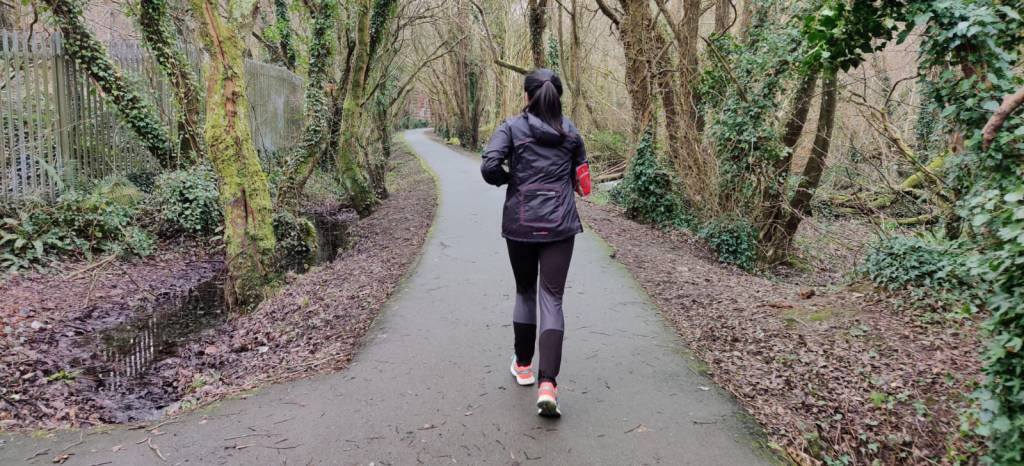
While I had intended to do my long run on a Sunday and instead spend the morning sleeping in and having a bit of a break, my brother had other plans and decided to drag me out on a 12km run, which ended up being a 13km, nearly 14km run but I had to say (even though I still resented him for dragging us out in the cold and into the middle of the woods on a Saturday morning), I had to thank him for actually dragging my sorry ass out of bed and actually making me do my long run.
Its strange, having to run with someone else instead of doing it all alone. I have always been more of a solo kind of girl when it comes to running but my brother may be just about the one person so far I don’t mind running with as long as he doesn’t try to run ahead of me or drive me mad with his crazy rants. Some research has shown that running with someone increased calmness in a person, although it may lead to higher levels of fatigue (although I felt calm, I didn’t really feel tired because I was running really slowly). However, the authors did point out the possibilities of a person’s relationship with the other runner playing a role in whether they may remain calmer during running so not sure how this might pan out when I run with people I’m not too familiar with.
Also, even though its a pain to drag my ass out of bed so early in the morning, the feeling of having completed a run (even though I know I’m in for 3 hours of volleyball training hell tonight) is the best. A study conducted on 51 adolescents found that even with just 30 minutes of running in the morning 5 days a week for three consecutive weeks slept better, had better concentration along with improved mood (Kalak et al., 2012). Quite interestingly, in a study conducted by Tomporowski (2002), he found that if a person were to exercise for too long that leads to dehydration, this might actually affect their cognitive functioning, causing them to perform more poorly on tasks involving information processing and memory functions.
After learning some various theories on how to get on my feet and go through this plan of running a marathon, I came to find SMART goals something I should have done after trying to come up with a mad schedule that I have since come to alter. SMART, a term coined by Doran, Miller and Cunningham (1981) stands for five criteria a person should meet when setting goals; specific, measurable, attainable, relevant and timely. Looking at how I had first set up my schedule, I now feel like an idiot for not having followed the instructions given to me and had put myself at the unnecessary risk of hurting myself.
Johnson, Moore and Thornton (2014) have a nice example of how to use SMART goals to motivate physical education in school children across a semester, which I will break down into what I had not done following this system and what I should do.
| Specific | Measurable | Attainable | Relevant | Timely |
| What I didn’t do:while I did write down that I had to go running at some point, I didn’t exactly come up with what type of run I should do to strengthen myself. What I should do:- incorporate various types of runs into my training plan to enable myself to build up various muscles needed for the long run. | This was just about the only thing I did right. I downloaded Strava and that helped me record how far I ran as well as how long it took for me to run so that was a good thing. | What I didn’t do: I was mad enough to think I could do two 8km runs twice a week as well as increasing my long run mileage by 2km every week. What I should have done:- pace myself out across the week and actually set distances that wouldn’t both make me keel over when thinking about doing them and actually forming a plan that wouldn’t hurt me. | What I didn’t do: I only wanted to do long runs since I am not a fan of fartleks and tempo runs but if I do not do those, it would affect my body’s preparation for the marathon. What should I do:- incorporate runs that would help benefit my body’s endurance | What I didn’t do: I was looking at doing two one hour runs a week, not including the long run and can e very time consuming, especially with me having to incorporate my volleyball training into this. What I should do?- come up with days where I do certain runs that do not use as much time e.g. Tempo runs or Fartlek |
After learning these in class, I’m going to use this knowledge to my advantage and use them to come up with a plan to run this marathon and achieve the goal of actually finishing it. Although I have the Anglesea half-marathon to worry about first thats happening on the 1st of March 2020 so fingers crossed on that.
Until then, peace out and stay tuned for more information on my journey to training for Born to Run.
References:
Doran, G. T. (1981). There’sa SMART way to write management’s goals and objectives. Management review, 70(11), 35-36.
https://runrepeat.com/state-of-running
Johnson, C., Moore, E., & Thornton, M. (2014). A SMART approach to motivating students in secondary physical education. Journal of Physical Education, Recreation & Dance, 85(4), 42-44. Retrieved from https://search-proquest-com.ezproxy.bangor.ac.uk/docview/1519968449?accountid=14874
Kalak, N., Gerber, M., Kirov, R., Mikoteit, T., Yordanova, J., Pühse, U., . . . Brand, S. (2012). Daily Morning Running for 3 Weeks Improved Sleep and Psychological Functioning in Healthy Adolescents Compared With Controls. Journal of Adolescent Health, 51(6), 615-622.
Morris, J. (2007, 11). Reach your dreams. Listen, 61, 20-21. Retrieved from https://search-proquest-com.ezproxy.bangor.ac.uk/docview/230522860?accountid=14874
Plante, T. G., Coscarelli, L., & Ford, M. (2001). Does exercising with another enhance the stress-reducing benefits of exercise?. International Journal of Stress Management, 8(3), 201-213.
Tomporowski, P. D. (2003). Effects of acute bouts of exercise on cognition. Acta psychologica, 112(3), 297-324.
This is an example post, originally published as part of Blogging University. Enroll in one of our ten programs, and start your blog right.
You’re going to publish a post today. Don’t worry about how your blog looks. Don’t worry if you haven’t given it a name yet, or you’re feeling overwhelmed. Just click the “New Post” button, and tell us why you’re here.
Why do this?
The post can be short or long, a personal intro to your life or a bloggy mission statement, a manifesto for the future or a simple outline of your the types of things you hope to publish.
To help you get started, here are a few questions:
You’re not locked into any of this; one of the wonderful things about blogs is how they constantly evolve as we learn, grow, and interact with one another — but it’s good to know where and why you started, and articulating your goals may just give you a few other post ideas.
Can’t think how to get started? Just write the first thing that pops into your head. Anne Lamott, author of a book on writing we love, says that you need to give yourself permission to write a “crappy first draft”. Anne makes a great point — just start writing, and worry about editing it later.
When you’re ready to publish, give your post three to five tags that describe your blog’s focus — writing, photography, fiction, parenting, food, cars, movies, sports, whatever. These tags will help others who care about your topics find you in the Reader. Make sure one of the tags is “zerotohero,” so other new bloggers can find you, too.

 Born to run blog